There is nothing original about how opinionated news coverage is. It's tempting to say 'how opinionated the media has become' but it's an old story. Even in the best cases there's a subtle angle or two going on in a story; at worst: well you don't have to look far or read deeply. It used to be that only advertisements and special interest messages or full page buy-ins blended message and content into a delicious slurpee of fact and fantasy. Nowadays there is editorializing run amok. A story can't rest, a tragedy can't be digested, before it is processed into agenda and counter-agenda.
As if there were not enough conflict in the world, and as if easy conclusions were not bountiful [and cheap] enough already, there is the great fight in mass media. No wonder the narrative of the contemporary is blurry: it is being constantly retouched by a cabal as neurotic and sinister and widespread as 40's Stalinist revisionists. They are your friends and your enemies, and they have your neighbor's ear if not yours. You will hear what they say, one way or another, and it may occur to you that it can't matter anymore what you think.
Naturally there is still room to read between the lines. For the claustrophobic, it is not recommended to try: the story there is generally not encouraging either. Everything surrounding it is manic, fallacious, and consistently problematic. User Comment Rodeos are a good joke but really, what an exercise in futility – in the name of some laughs, hopefully. There has to be an 'at least', and that is that we can watch the corrosion of debate and solidification of mistruth, and at least laugh about it.
I am late to that party, but even I can tell it contains some excellent observations by noteworthy members. Stephen Colbert, for one: host of the Daily Show for the 21st century. Generally the news isn't jokeworthy, and turning it into something laughable takes direct confrontation of its most negative features. Held only in context, it's kind of macabre to laugh when 'people are dead/dying'... but if you follow that rabbit hole all the way down you will lose your mind. What matters about Colbert, for instance, is that his stance is based on perspective as well as overwhelming satire. Still, I admit I am no expert, so it could be something else with his show.
What does a politics/satire late night show have to do with news media, worldwide? Only very little: an example of the brighter side. Mostly the news media that exists is corporate in nature and consumerist in action. Generally, Western media is overwhelmingly capitalistic as well, but even to bring that up anecdotally is grounds for suspicion and/or derision, which only makes it truer. When the Rana Plaza Building collapsed in Bangladesh it didn't take long for the apologists and exceptionalists to hurl their agendas into the fray. 'It's a recession, so you know what? The solution is a growing global market, stupid hippies, and that requires affordable labor.' or 'Before you pontificate about these 500 dead garment workers, just remember that many were working women – an economic and feminist victory for that country.' or 'If you think you should feel guilty about that 29 dollar t-shirt made by a worker paid pennies an hour think about these even poorer places where subsistence farmers aren't even exploited by billion-dollar multi-national corporations!'
These are the kinds of things that develop from an overly opinionated media. The story itself was buried in the rubble of a society scrambling to indemnify itself against all charges of complicity. The careful thoughtfulness which can only come from an understanding of things is ever eclipsed by the need to feel strongly about things, to feel superior to or protected from problems, and [for 'a lucky few'] to exploit strong feelings for profit or power. This is nothing new, and is probably a fundamental limit on any possibility of a human solution to the problem. What plagued us as suspicious tribes slaughtering each other in the Neolithic will plague us with nuclear weapons, drone strikes, surveillance, social unrest, and terrorism in the present.
Yeah, I'm getting all of this from a handful of unqualified public user internet commentary, some TV shows, and the odd newspaper. I sometimes cover user comment posts - it seems like a frightening low, come to think of it. Still, all of these things say something about contemporary society. Even the agendas, approached critically, sometimes reveal a little about their motivations. Still, it is not the done thing to wonder about the world. All minds bog down with immediate concerns: on that account there is either no blame to spread or too much to imagine. However, it is and has always been important to open one's eyes now and again, to accept the surprise of being wrong, and there are [in the media alone] too many entrenched positions for that to be true.
As a lowly member of the public, I feel from the media world little other than indifferent contempt – with few exceptions. I don't understand how everyone doesn't feel that way. Companies/governments/media outlets talk down to me all day, in advertisements and productions in every form of media, their lackeys on the street, the social mores they've normalized, the behaviors they encourage, police, cause, and propagate. If I think differently than I ought to, things will seem grimmer than they have to, and maybe that's unhealthy. 'Being happy is being healthy, so even in inclement times, you should focus on you, and be happy!'
Of course, feeling uncomfortable about this situation is absurd, abnormal, or paranoid. The cues are everywhere and they tell me to continue to consume the media, maintain or improve my standing in society, and that things are getting better every day. 'The future is coming, along with the following exciting products and services...'
There will always be 'incidents' and your betters and heroes in politics, business, and the media will cover those. You will know what to think the minute you hear any story, without hesitation or reflection. You might have overblown fights with complete strangers about something trifling you disagree on, but you'll never question why. The irrelevance of opinion [and opinions' sources] is the only thing in doubt. There might be opinions published in and around the news that are unacceptable because they are one-sided and/or myopic, but at least they're only kinda presented as truth, in the sense that they are argued convincingly but never based on facts.
Oh well. Agree to disagree. The headlines will confirm what you were thinking anyway. Whatever you do: don't search for cures - your old friends are waiting for you.
5/24/13


5/18/13
The Character Assassination of Robert B. Ford
It was, all in all, a great week for Toronto. The possibility of a downtown casino had been quashed by the premier, another condo development had been announced (this one will replace the aging, unsightly, and low-density Fort York), and the numbers proved what citizens had known for ten years: public transit was highly popular, perhaps too popular. All the city needed was another news story or an influx of tourists, and the golden summer of 2013 could begin.
Nobody could have expected that the greatest news story of all time would descend, causing a vortex of mad news that would spread across the world. A truly world-class story would emerge from the general rubbish of Toronto news (three parts middle-class entitlement to one part crime/poverty stories) and take the world by storm – even better: it would lead to worldwide news coverage.
Noteworthy Rob Ford hater and inveterate populist newspaper The Toronto Star had been at the forefront of research into the newest Rob Ford Media Fiasco. However, when the story became too hot for the Canada/US border it was broken by a New York based internet company, Gawker. One gets the impression of a sweating editorial meeting at the Star, shirtsleeves and pantsuits, the editor in chief wearily smoking a cigarette and shaking her head - 'They scooped us, Jesus Christ, that was our story! One more fuck up like this and we're done!' Never mind, of course, that if the Toronto Star had reported on the story first it would never have become a world-class piece of news.
It was the hottest piece of Canadian hearsay since that fuddle-duddle about Laureen Harper, which many still do not know and got to be so hot it involved the RCMP. Even the Laureen Harper rumors failed to capture the world's attention – most likely since they only existed in Ottawa, where they were firmly proved, before the media was scared with warnings about tangling with the Prime Minister's Office and the RCMP. Well, move along, old story. Here's a golden one: Rob Ford smokes crack. Allegedly, because the drug dealers who have the video aren't letting it go for less than $100,000 at least, and double that for U.S. media outlets. Nobody's bought it yet, but those young entrepreneurs are proving that you don't need education or ethical high ground to make the news! Truly they are sending a good message in the Recession Era for self starters everywhere.
What do you think of that? That's absolutely world class, and the media is acting like it's shameful. In a country where senators are getting away with fraudulent misuse of taxpayer money, and the government generally looks down on the populace, the private enjoyment of privately-funded crack cocaine by a family man and Mayor of Toronto seems to be the Goliath of news. In reality it isn't even that newsworthy at all: Canada is a real country and things happen outside of Toronto. However, there is an element of schadenfreude in all this: Canada hates Toronto and the most vocal parts of Toronto hate Rob Ford. Everyone wins with a story like this.
Toronto should embrace this man, but establish firm limits on his ability to gut downtown or mass transit. Rob Ford is a brilliant statesman in the new mode: what matters is politics as a game. Promise the people what they want and then go forth, and do what you want. Words to live by. In America he would be a millionaire CEO, a Senator, or a Governor. Since it's America, he probably wouldn't have strayed far from powder cocaine. In Canada he is a Michael Bloomberg - a Canadian Billionaire and a Mayor, and possibly a Man Who Smoked Crack. This is truly world class, and Toronto owes him for his services, for the media exposure, and for the good times.
Most importantly, Rob Ford is a tenacious fighter and a winner. He has faced incredible backlash since before he was Mayor. He was the dissolute son of a rich man, they said, and just another byproduct of the broken North American Democracy. They thought he wasn't built of the right stuff, but as it turns out, Rob Ford is. Every failure of optics has been overcome, from the anger management issues, to the balance issues, to the aggressive cameraman issues. Nobody in Canadian politics is man enough to deal with Ford, and that fear is what contributes to the largely biased and negative coverage.
In a daring show of solidarity with the poor addicts of the world, Rob Ford smoked crack. He is rich enough to enjoy powder cocaine, but he wanted to let the world know that rich people can get down with rocks too, we're all generally the same - some of us are just rich enough to govern the rest. Isn't that the American Dream come to life in Center-Right Socialist Canada? Rob Ford is truly a contender in politics, unlike generally all other politicians, he isn't afraid of crime, drugs, or poor people. If his people are smart enough to spin this story the right way, he will be Prime Minister in ten years, and then the fun can really begin!
Nobody could have expected that the greatest news story of all time would descend, causing a vortex of mad news that would spread across the world. A truly world-class story would emerge from the general rubbish of Toronto news (three parts middle-class entitlement to one part crime/poverty stories) and take the world by storm – even better: it would lead to worldwide news coverage.
Noteworthy Rob Ford hater and inveterate populist newspaper The Toronto Star had been at the forefront of research into the newest Rob Ford Media Fiasco. However, when the story became too hot for the Canada/US border it was broken by a New York based internet company, Gawker. One gets the impression of a sweating editorial meeting at the Star, shirtsleeves and pantsuits, the editor in chief wearily smoking a cigarette and shaking her head - 'They scooped us, Jesus Christ, that was our story! One more fuck up like this and we're done!' Never mind, of course, that if the Toronto Star had reported on the story first it would never have become a world-class piece of news.
It was the hottest piece of Canadian hearsay since that fuddle-duddle about Laureen Harper, which many still do not know and got to be so hot it involved the RCMP. Even the Laureen Harper rumors failed to capture the world's attention – most likely since they only existed in Ottawa, where they were firmly proved, before the media was scared with warnings about tangling with the Prime Minister's Office and the RCMP. Well, move along, old story. Here's a golden one: Rob Ford smokes crack. Allegedly, because the drug dealers who have the video aren't letting it go for less than $100,000 at least, and double that for U.S. media outlets. Nobody's bought it yet, but those young entrepreneurs are proving that you don't need education or ethical high ground to make the news! Truly they are sending a good message in the Recession Era for self starters everywhere.
What do you think of that? That's absolutely world class, and the media is acting like it's shameful. In a country where senators are getting away with fraudulent misuse of taxpayer money, and the government generally looks down on the populace, the private enjoyment of privately-funded crack cocaine by a family man and Mayor of Toronto seems to be the Goliath of news. In reality it isn't even that newsworthy at all: Canada is a real country and things happen outside of Toronto. However, there is an element of schadenfreude in all this: Canada hates Toronto and the most vocal parts of Toronto hate Rob Ford. Everyone wins with a story like this.
Toronto should embrace this man, but establish firm limits on his ability to gut downtown or mass transit. Rob Ford is a brilliant statesman in the new mode: what matters is politics as a game. Promise the people what they want and then go forth, and do what you want. Words to live by. In America he would be a millionaire CEO, a Senator, or a Governor. Since it's America, he probably wouldn't have strayed far from powder cocaine. In Canada he is a Michael Bloomberg - a Canadian Billionaire and a Mayor, and possibly a Man Who Smoked Crack. This is truly world class, and Toronto owes him for his services, for the media exposure, and for the good times.
Most importantly, Rob Ford is a tenacious fighter and a winner. He has faced incredible backlash since before he was Mayor. He was the dissolute son of a rich man, they said, and just another byproduct of the broken North American Democracy. They thought he wasn't built of the right stuff, but as it turns out, Rob Ford is. Every failure of optics has been overcome, from the anger management issues, to the balance issues, to the aggressive cameraman issues. Nobody in Canadian politics is man enough to deal with Ford, and that fear is what contributes to the largely biased and negative coverage.
In a daring show of solidarity with the poor addicts of the world, Rob Ford smoked crack. He is rich enough to enjoy powder cocaine, but he wanted to let the world know that rich people can get down with rocks too, we're all generally the same - some of us are just rich enough to govern the rest. Isn't that the American Dream come to life in Center-Right Socialist Canada? Rob Ford is truly a contender in politics, unlike generally all other politicians, he isn't afraid of crime, drugs, or poor people. If his people are smart enough to spin this story the right way, he will be Prime Minister in ten years, and then the fun can really begin!
5/9/13
Has the Golden Era of Adblockers Passed?
Recently I tried to watch some online video on a television channel's website. The video applet failed to load completely and it didn't take long for me to develop the correct suspicion. I disabled my adblocker and reloaded the page. No fucking video. So I open the page in a vanilla browser and it loads, a wild contrast from what I had, up till that point, been used to. On the vanilla browser there is a banner and large square add. Then the video starts and I am subjected to extra-loud advertising, TV style, with a vengeance. In addition to the other adds. Another advertisement plays, and a third, before my content is loaded.
Adblockers, with the advent of hijacked banner ads and unscrupulous marketing, to say nothing of the paranoid or political users of the internet, are not simply a tool entitled users employ to rid themselves of annoyances. Ad-blockers are legitimately a way of keeping your computer clean, of preventing your oft-used technological distractions from compromise. The fact you don't have to watch commercials (which are basically always: manipulative, insulting, indoctrinating or some shameful combination of all three) is an added bonus to not having your internet-accessing-device fucked with.
I am not a poweruser but I've been adblocking for years - since I discovered it was possible. I understand that advertising revenue drives some smaller sites, and, yes, I'd agree they deserve their due - assuming they police their advertisements for some level of quality. Fine, whatever, have your .005 cents per impression. You deserve it, plucky little website. However, the worst offenders are often large media sites – sometimes even those which already use paywalls. Let me present a brief overview of the galloping trend of online advertising.
In the early 90's during the second wave of the internet, when things became graphical enough that advertisement in the classic sense became possible, it was largely internet entities that advertised for themselves, and certain forward looking companies often related to the tech-sector. It was a simpler time. By late 1999 basically everyone who wasn't under a rock or a dinosaur was getting into online advertisement. 'Hey, check out our website at http://www.geocities.SonnysPizza/index.htm for some coupons' and other types of hilarity abounded. Whatever, wherever you got advertised to, it took a slice of your pitiful bandwidth and generally wasted time and resources, but you had to face it. Eventually MSN Messenger (R.I.P) becomes huge, and eventually it begins to advertise to you.
Side banner; top banner; .gif flames - all of these things were familiar. Between then and now the internet has grown up and come of age to the point where a huge section of people use it. All the troglodytes, termites, attractive well-adjusted people, and infants came out of the woodwork and the internet is full of everyone now. Whatever, other people will tell you about it, and some gigantic nerd could probably make a convincingly venomous deal about it... all I'll say is it drove a wave of advertising intensity that eventually rivaled the notorious realm of television adverts.
Fucking pop-ups were one thing, but there came layers of advertising that would jump into existence around key-words. Video sidebars that glitched out your browser and had to fling their audio payloads into your ears. 'Interactive' commercials made by committees of dullards and shills. YouTube videos became clogged with side, top, and skippable pre-video advertisements for every user account considered important enough to waste your time for their profit. What was once dumb, became even dumber, amen. So it goes, right? Absolutely. Yet there were additions to your browsers that would kill all advertising.
True to form, adblockers were free. They worked, and nobody who adopted them ever looked back. Surfing without them was like going back in time. It sucked, you were exposed to all the reprehensible shit that barely existed in your ideal internet experience. Going back to ads is like hitting yourself in the face with a shoe. Beautiful adblocking programs, released by benevolent and right-minded developers, worked on classic print ads, video ads, and even ads played in video content. It is like a magic balm that drives mosquitoes far, far away. For those who use adblockers, the internet just is that much less shitty. It's less claustrophobic and it can seem like the terminal cash-in state of the world has been opposed.
So of course, it comes to an end, by hosted content ('hosting ain't free, yo') which a profitable broadcaster puts online. Until very recently I had never been blocked for anything but geographical reasons (though nationalization of the internet is another ugly recent phenomenon) but a week or two ago I was denied a show I had been following online. I imagine in a year it will be impossible to skip video-advertisements everywhere, and only the smug power users will know what to do about it. Hopefully the same people who did the good work of blocking online advertising will keep up and their programs will not lapse into irrelevance due to some frightening and monstrous online advertising epidemic.
Because what the hell? You're running a profitable business already, and why not add some more revenue? Why not even more? Why not three advertisements every five-and-a-half minutes on video content? Why not have it be 30% louder than actual content, like on TV? Who cares is the commercial is ideologically loaded or bankrupt of all value? Who cares if it's annoying? 'I like money, gentlemen, and nobody gets a free lunch!'
A browser without an adblocker is a sign of a pitiable person trapped in the commercial arena, a hopeless square, a submissive lackadaisical fuck, a worthless shit hyperbole rapist. This is one fight the internet should not lose.
Adblockers, with the advent of hijacked banner ads and unscrupulous marketing, to say nothing of the paranoid or political users of the internet, are not simply a tool entitled users employ to rid themselves of annoyances. Ad-blockers are legitimately a way of keeping your computer clean, of preventing your oft-used technological distractions from compromise. The fact you don't have to watch commercials (which are basically always: manipulative, insulting, indoctrinating or some shameful combination of all three) is an added bonus to not having your internet-accessing-device fucked with.
I am not a poweruser but I've been adblocking for years - since I discovered it was possible. I understand that advertising revenue drives some smaller sites, and, yes, I'd agree they deserve their due - assuming they police their advertisements for some level of quality. Fine, whatever, have your .005 cents per impression. You deserve it, plucky little website. However, the worst offenders are often large media sites – sometimes even those which already use paywalls. Let me present a brief overview of the galloping trend of online advertising.
In the early 90's during the second wave of the internet, when things became graphical enough that advertisement in the classic sense became possible, it was largely internet entities that advertised for themselves, and certain forward looking companies often related to the tech-sector. It was a simpler time. By late 1999 basically everyone who wasn't under a rock or a dinosaur was getting into online advertisement. 'Hey, check out our website at http://www.geocities.SonnysPizza/index.htm for some coupons' and other types of hilarity abounded. Whatever, wherever you got advertised to, it took a slice of your pitiful bandwidth and generally wasted time and resources, but you had to face it. Eventually MSN Messenger (R.I.P) becomes huge, and eventually it begins to advertise to you.
Side banner; top banner; .gif flames - all of these things were familiar. Between then and now the internet has grown up and come of age to the point where a huge section of people use it. All the troglodytes, termites, attractive well-adjusted people, and infants came out of the woodwork and the internet is full of everyone now. Whatever, other people will tell you about it, and some gigantic nerd could probably make a convincingly venomous deal about it... all I'll say is it drove a wave of advertising intensity that eventually rivaled the notorious realm of television adverts.
Fucking pop-ups were one thing, but there came layers of advertising that would jump into existence around key-words. Video sidebars that glitched out your browser and had to fling their audio payloads into your ears. 'Interactive' commercials made by committees of dullards and shills. YouTube videos became clogged with side, top, and skippable pre-video advertisements for every user account considered important enough to waste your time for their profit. What was once dumb, became even dumber, amen. So it goes, right? Absolutely. Yet there were additions to your browsers that would kill all advertising.
True to form, adblockers were free. They worked, and nobody who adopted them ever looked back. Surfing without them was like going back in time. It sucked, you were exposed to all the reprehensible shit that barely existed in your ideal internet experience. Going back to ads is like hitting yourself in the face with a shoe. Beautiful adblocking programs, released by benevolent and right-minded developers, worked on classic print ads, video ads, and even ads played in video content. It is like a magic balm that drives mosquitoes far, far away. For those who use adblockers, the internet just is that much less shitty. It's less claustrophobic and it can seem like the terminal cash-in state of the world has been opposed.
So of course, it comes to an end, by hosted content ('hosting ain't free, yo') which a profitable broadcaster puts online. Until very recently I had never been blocked for anything but geographical reasons (though nationalization of the internet is another ugly recent phenomenon) but a week or two ago I was denied a show I had been following online. I imagine in a year it will be impossible to skip video-advertisements everywhere, and only the smug power users will know what to do about it. Hopefully the same people who did the good work of blocking online advertising will keep up and their programs will not lapse into irrelevance due to some frightening and monstrous online advertising epidemic.
Because what the hell? You're running a profitable business already, and why not add some more revenue? Why not even more? Why not three advertisements every five-and-a-half minutes on video content? Why not have it be 30% louder than actual content, like on TV? Who cares is the commercial is ideologically loaded or bankrupt of all value? Who cares if it's annoying? 'I like money, gentlemen, and nobody gets a free lunch!'

A browser without an adblocker is a sign of a pitiable person trapped in the commercial arena, a hopeless square, a submissive lackadaisical fuck, a worthless shit hyperbole rapist. This is one fight the internet should not lose.
4/25/13
Sim City 5 and The Future of Video Games
The following rule is one you will never be taught in business school, but it stands: franchises should sometimes be allowed to die. Krispy Kreme, American Idol, Star Wars, and now Sim City. Say what you want about any of these IPs/businesses, they've fallen on hard times and their only relevance seems to come from apathy. Krispy Kreme for example built a highly profitable business empire on sweet and fatty doughnuts, but even the ignorant serfs who regularly eat such things as doughnuts are beginning to understand that healthy food can help improve quality of life as well as exercise little-known taste buds which are not related to grease or sugar. Unhealthy industries, eh? Well I've got one of the best under my microscope right now...
In the often boring, sexist, shallow world of video games and video game culture –"a fantasy realm where nerds rule!"– franchises are the only safe bets. Who wouldn't bankroll a new Mario game? Which executive wouldn't give the go-ahead to a new multiplayer FPS? Everyone can see the dollar signs when World of Warcraft comes up - so lets make everything an MMO from now on. Many franchises stem from much-beloved games from the comparative stone age of video gaming. No, not the 70s - my bad. To be clear: the copper age of video gaming, the 1990s. It is an era which is reviled by the current generation of gamers, and old gamers who enjoy modern games (AKA: stunted adults), as the era of 'rose-tinted glasses'.
Age of Empires, Call of Duty, Sim City, Diablo, Warcraft, Starcraft, Command & Conquer, Doom, Quake, Half-Life, Mario 64, TLoZ: Ocarina of Time, System Shock, Civilization, Aliens vs. Marines, Gran Turismo, Need for Speed, Mortal Kombat... the list goes on, but the point stands: the 90s produced an overwhelming amount of remarkable computer games which were part of or formed the basis for highly profitable franchises. Eventually all of these were bought up by a couple now-monolithic publishers and developers. To put this in perspective, imagine all the mortgages that were packaged into junk bonds in the Financial Crisis of 2008 were sound before they were bought, gutted, and packaged into toxic assets by the monolithic banks and sold to incredibly loyal and gullible customers. This is essentially what happened to most beloved video game franchises in the last ten or fifteen years.
The specifics are open to debate, the pillaging of each franchise is also arguable, but in the contemporary scene all you really get is cutting-edge graphics, a semblance of a story, and shallow treadmill mechanics that dare you to find a reason to play for more than a month. You get quality without substance. Games with the addictive potential of crack cocaine and with exactly the same intoxication profile, creating users and addicts that are indistinguishable from the real thing in their disgusting, annoying race to the bottom. World of Warcraft, it's your move.
All of this is old news, however. I want to focus on one game which was recently released to great fanfare after building up a considerable amount of hype. It is the newest entry in a venerable franchise which was begun in 1989 - Sim City 5. If you haven't heard of it you pay no attention to video games at all because it is the biggest story of the year. Unfortunately, it is a story that has become far too common. But enough words, allow a picture to do the talking:

Metacritic never lies, but as an aggregate it can blur the truth. Video game journalism is instrumental in the downfall of gaming. Even nixing all the outliers (too positive or negative), critical response is completely away in fantasy land compared to user reviews (people who have paid to play the game and were not paid to review a potentially free copy). If you ever want to see what happened, simply compare a modern video game magazine (like PC Gamer for instance) to an issue from ten or more years ago. Not only is there less content than ever, but there are more ads, weaker reviews, and a typical lack of insight. All journalism falls down from time to time, but in a less critical market like Video Game Culture Magazines you can see how far it can fall.
Nintendo Power is over, though. This is the era of Sim City 5000, by EA Interactive. The game that arrived amidst thunderous applause and then faced an immediate backlash over: always-online gameplay, resulting server overload, dumb simulation design, and bugs. Lots of bugs. The game looks really pretty and that's the nicest thing you can honestly say about it. I feel bad for the people who made this game. It seems like they didn't have enough time to finish making it. But it looks really good, and the marketing was top notch.
Sim City 5 lacks many features people took for granted in earlier games in the series, and the features it has substituted for them don't work well or don't work at all. Sim City 4 was doing the same thing but managed to work as a game that people liked. Sim City 3 even ditched some of Sim City 2000's best concepts - the series peaked in the mid 90's and almost twenty years later: here we are. Well, I don't know why games are getting worse and dumber every year, and I don't think it matters, so I'll leave that to the experts. Games were never smart, but god damn remember how Duke Nukem used to be fun? Remember the wide variety of games that used to exist? Remember how they took a long time to master? I don't hate casual gaming and I don't hate modern gaming (per-se) I just want to point out some other, more successful, notorious sequels:
Heroes 4: it was a great design decision to drop everything that made a Heroes game a Heroes game and borrow heavily from other turn based strategy games. It looks and plays like a shitty version of Age of Wonders 2, except it doesn't even have hexes, which makes it so unbearable that even longtime defenders of the series say 'It's an interesting take on the genre.' The series (5 and 6!) is now a graphical powerhouse with dumbed down everything and it holds your hand while you play, making cooing noises to sooth your mind.
Call of Duty 4?5?/Modern Warfare/Black Ops: It's always cool to play games online where you shoot other players while the world goes to shit around you. Single player games in this era should be expected to complete themselves and introduce core concepts so that gamers can move into multiplayer.
Battlefield: The good ol' days of 1942 are gone, and in its place are dozens of futuristic mechanics lifted from the Call of Duty series! It's really cool to play with 12 year olds and shoot guns, guys! It's still cool! Adults do it, so don't feel bad about yourself! Graphics are really good. Sound is good. Talk about smoking weed while shooting people on the internet!
Diablo 3: The mother of all hack 'n slash gets overdeveloped. Plays smooth, looks really good, professional and it works. Gameplay and story that hold your hand and never let you go, like helicopter parents, except worse. Story literally gets in the way of gameplay. Takes away player agency and control with 'fear' mobs - multi-million dollar design at work. Revolutionary skill system is boring, advantageous skills are patched into the ground, play for 30 hours to get to the endgame, which is doing the same thing over and over. Campy, dumb bosses from hell. Always online. Play with friends (but no more than three at a time with no significant interaction). Good equipment has to be bought and sold for maximum profit on an auction house that should but doesn't form a community. Drop rates are worse than Vegas. Items are boring: required level 52 for a ring that has a socket in it and nothing else. Stats and crits and nothing else. There is nothing else. Soulless, hackneyed, cliched cash-in that manages to make its hackneyed cash-in older brothers look like cool adults. People who defend this game are the same people who have ruined gaming - they are responsible for Sim City 5. Real Money Auction House! Brilliant! 'Blizzard, O Blizzard, what has become of ye? I remember ye best in 2001, after nearly a decade of fun.'
Skyrim/Oblivion: Super-duper graphics, uninspiring story that holds you by the hand, bland gameplay. Hack, slash, loot for unexciting items. Monsters level with you. No learning curve. Typos, bad writing. Less skills, less uncertainty, less quests, less fun - more scripted events, more voice actors, more polygons, more limits. Doing less with more. Inventory systems so terrible that playing is never not a chore. No reason to follow series after Morrowind: which was a chore to play but somehow a worthy chore. Rest in boring, complacent success The Elder Scrolls.
The Legend of Zelda: Skyward Sword: A game that is relentless about never letting the player think or reason a solution. Holds your hands to the Nth degree. Emblematic of modern video games: no player agency, nothing is open: products for children that assume a level of stupidity that manages even to annoy children. Hold my hand, railroad design, pop up messages every minute.
Duke Nukem Forever: Boring, plastic, lifeless... there's a joke in there somewhere - and that's just the game! Emblematic of what happens to every franchise in this brave new world.
There are many more senile series out there. I don't know if developers are getting lazy, or if they actually think they're doing anything more than sober, diligent, professional work. Probably they don't care: get your paycheque, do your work, keep your head down, follow the money. Creativity is being starved out of the industry, and indie games are not going to save the day. Well, whatever, I suppose it was time for me to grow up anyway, and put away such childish, M-rated things.
In the often boring, sexist, shallow world of video games and video game culture –"a fantasy realm where nerds rule!"– franchises are the only safe bets. Who wouldn't bankroll a new Mario game? Which executive wouldn't give the go-ahead to a new multiplayer FPS? Everyone can see the dollar signs when World of Warcraft comes up - so lets make everything an MMO from now on. Many franchises stem from much-beloved games from the comparative stone age of video gaming. No, not the 70s - my bad. To be clear: the copper age of video gaming, the 1990s. It is an era which is reviled by the current generation of gamers, and old gamers who enjoy modern games (AKA: stunted adults), as the era of 'rose-tinted glasses'.
Age of Empires, Call of Duty, Sim City, Diablo, Warcraft, Starcraft, Command & Conquer, Doom, Quake, Half-Life, Mario 64, TLoZ: Ocarina of Time, System Shock, Civilization, Aliens vs. Marines, Gran Turismo, Need for Speed, Mortal Kombat... the list goes on, but the point stands: the 90s produced an overwhelming amount of remarkable computer games which were part of or formed the basis for highly profitable franchises. Eventually all of these were bought up by a couple now-monolithic publishers and developers. To put this in perspective, imagine all the mortgages that were packaged into junk bonds in the Financial Crisis of 2008 were sound before they were bought, gutted, and packaged into toxic assets by the monolithic banks and sold to incredibly loyal and gullible customers. This is essentially what happened to most beloved video game franchises in the last ten or fifteen years.
The specifics are open to debate, the pillaging of each franchise is also arguable, but in the contemporary scene all you really get is cutting-edge graphics, a semblance of a story, and shallow treadmill mechanics that dare you to find a reason to play for more than a month. You get quality without substance. Games with the addictive potential of crack cocaine and with exactly the same intoxication profile, creating users and addicts that are indistinguishable from the real thing in their disgusting, annoying race to the bottom. World of Warcraft, it's your move.
All of this is old news, however. I want to focus on one game which was recently released to great fanfare after building up a considerable amount of hype. It is the newest entry in a venerable franchise which was begun in 1989 - Sim City 5. If you haven't heard of it you pay no attention to video games at all because it is the biggest story of the year. Unfortunately, it is a story that has become far too common. But enough words, allow a picture to do the talking:
Metacritic never lies, but as an aggregate it can blur the truth. Video game journalism is instrumental in the downfall of gaming. Even nixing all the outliers (too positive or negative), critical response is completely away in fantasy land compared to user reviews (people who have paid to play the game and were not paid to review a potentially free copy). If you ever want to see what happened, simply compare a modern video game magazine (like PC Gamer for instance) to an issue from ten or more years ago. Not only is there less content than ever, but there are more ads, weaker reviews, and a typical lack of insight. All journalism falls down from time to time, but in a less critical market like Video Game Culture Magazines you can see how far it can fall.
Nintendo Power is over, though. This is the era of Sim City 5000, by EA Interactive. The game that arrived amidst thunderous applause and then faced an immediate backlash over: always-online gameplay, resulting server overload, dumb simulation design, and bugs. Lots of bugs. The game looks really pretty and that's the nicest thing you can honestly say about it. I feel bad for the people who made this game. It seems like they didn't have enough time to finish making it. But it looks really good, and the marketing was top notch.
Sim City 5 lacks many features people took for granted in earlier games in the series, and the features it has substituted for them don't work well or don't work at all. Sim City 4 was doing the same thing but managed to work as a game that people liked. Sim City 3 even ditched some of Sim City 2000's best concepts - the series peaked in the mid 90's and almost twenty years later: here we are. Well, I don't know why games are getting worse and dumber every year, and I don't think it matters, so I'll leave that to the experts. Games were never smart, but god damn remember how Duke Nukem used to be fun? Remember the wide variety of games that used to exist? Remember how they took a long time to master? I don't hate casual gaming and I don't hate modern gaming (per-se) I just want to point out some other, more successful, notorious sequels:
Heroes 4: it was a great design decision to drop everything that made a Heroes game a Heroes game and borrow heavily from other turn based strategy games. It looks and plays like a shitty version of Age of Wonders 2, except it doesn't even have hexes, which makes it so unbearable that even longtime defenders of the series say 'It's an interesting take on the genre.' The series (5 and 6!) is now a graphical powerhouse with dumbed down everything and it holds your hand while you play, making cooing noises to sooth your mind.
Call of Duty 4?5?/Modern Warfare/Black Ops: It's always cool to play games online where you shoot other players while the world goes to shit around you. Single player games in this era should be expected to complete themselves and introduce core concepts so that gamers can move into multiplayer.
Battlefield: The good ol' days of 1942 are gone, and in its place are dozens of futuristic mechanics lifted from the Call of Duty series! It's really cool to play with 12 year olds and shoot guns, guys! It's still cool! Adults do it, so don't feel bad about yourself! Graphics are really good. Sound is good. Talk about smoking weed while shooting people on the internet!
Diablo 3: The mother of all hack 'n slash gets overdeveloped. Plays smooth, looks really good, professional and it works. Gameplay and story that hold your hand and never let you go, like helicopter parents, except worse. Story literally gets in the way of gameplay. Takes away player agency and control with 'fear' mobs - multi-million dollar design at work. Revolutionary skill system is boring, advantageous skills are patched into the ground, play for 30 hours to get to the endgame, which is doing the same thing over and over. Campy, dumb bosses from hell. Always online. Play with friends (but no more than three at a time with no significant interaction). Good equipment has to be bought and sold for maximum profit on an auction house that should but doesn't form a community. Drop rates are worse than Vegas. Items are boring: required level 52 for a ring that has a socket in it and nothing else. Stats and crits and nothing else. There is nothing else. Soulless, hackneyed, cliched cash-in that manages to make its hackneyed cash-in older brothers look like cool adults. People who defend this game are the same people who have ruined gaming - they are responsible for Sim City 5. Real Money Auction House! Brilliant! 'Blizzard, O Blizzard, what has become of ye? I remember ye best in 2001, after nearly a decade of fun.'
Skyrim/Oblivion: Super-duper graphics, uninspiring story that holds you by the hand, bland gameplay. Hack, slash, loot for unexciting items. Monsters level with you. No learning curve. Typos, bad writing. Less skills, less uncertainty, less quests, less fun - more scripted events, more voice actors, more polygons, more limits. Doing less with more. Inventory systems so terrible that playing is never not a chore. No reason to follow series after Morrowind: which was a chore to play but somehow a worthy chore. Rest in boring, complacent success The Elder Scrolls.
The Legend of Zelda: Skyward Sword: A game that is relentless about never letting the player think or reason a solution. Holds your hands to the Nth degree. Emblematic of modern video games: no player agency, nothing is open: products for children that assume a level of stupidity that manages even to annoy children. Hold my hand, railroad design, pop up messages every minute.
Duke Nukem Forever: Boring, plastic, lifeless... there's a joke in there somewhere - and that's just the game! Emblematic of what happens to every franchise in this brave new world.
There are many more senile series out there. I don't know if developers are getting lazy, or if they actually think they're doing anything more than sober, diligent, professional work. Probably they don't care: get your paycheque, do your work, keep your head down, follow the money. Creativity is being starved out of the industry, and indie games are not going to save the day. Well, whatever, I suppose it was time for me to grow up anyway, and put away such childish, M-rated things.
4/12/13
User Comment Rodeo: Generation Text; Its Detractors and Malcontents
A recent CBC article claims a few things so startlingly obvious that the sound of a gong ought to be looped over it. The findings demonstrated, and you might want to sit down for this one, that people who texted more (don't sweat, the breakpoint is 200 + texts) often tended to be less thoughtful than those who didn't. Also among the findings was the gem that the 200+ text club was (30%) more likely to be fixated on "wealth and image than an ethical life". Now, as unsurprising as this study's conclusions are, they are of limited truth.
Firstly, only teenagers or immature adults can actually muster up the energy to text more than 100 times a day. Yet I can be surprised by texting culture. At 15 seconds per text, 100 texts would only require a time investment of 25 minutes. Scale that any way you want, and remember that serial texters are quick, and it's easy to conclude that a serial texter can text 400+ times a day and still have lots of time left over to socialize 'face to face' (oh shit, that term is going to get worn out in the next few years). This 'texting' business, which is correctly SMSing business, has for many years now been a cultural crisis in the making. We all stepped in it with full confidence, so now we get to suffer it. Suffer the outrageous extremes of an increasingly dim and unfunny era.
You can already see what kind of User Comment Rodeo it's going to be. The best kind. Because you know the ageists, the trolls, the dickweeds, the self-described experts, the geniuses – in short the whole, illiterate, unwashed, entitled, self-satisfied mass of the public – is going to unable to prevent themselves from puking their word nonsense onto this story like tainted cocktail shrimp at a bad house party. Listen up, I know that serial texters are often total wankers. I understood years ago that they lacked the self-reflection expected of a great ape, dolphin, or crow. Don't forget that this study is biased: note that it focused on first year students. Don't buy into the hype without thinking critically about it first. First year students are so rarely aware of themselves that the study is unfair and biased. It stooped for low-hanging fruit when there are plenty of studies that can judge the adult narcissist sociopaths in business, finance, and politics.
But enough of my ado about nothing; let's have others' ado about nothing:
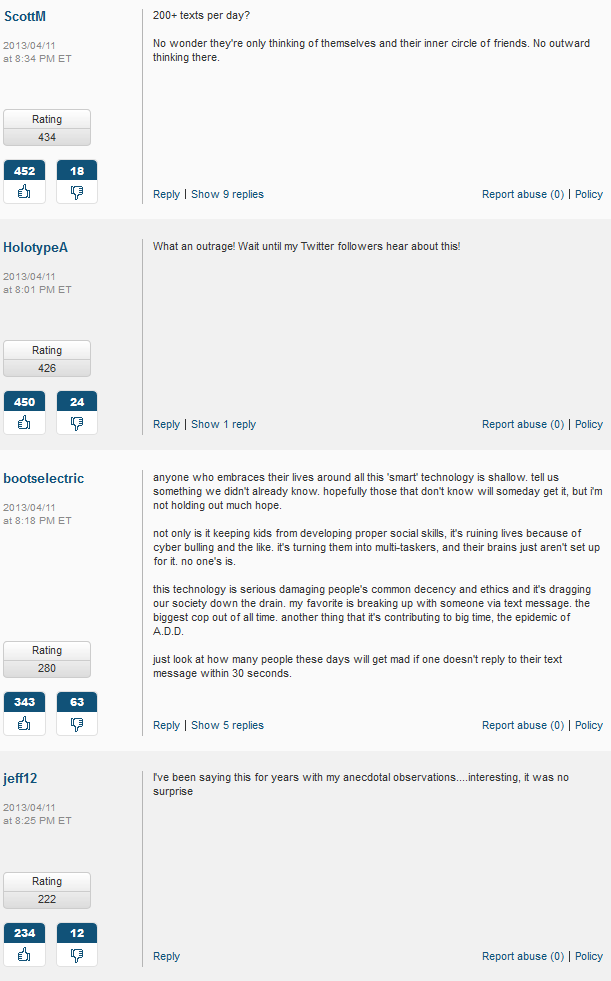
The cream of the crop, my friends. These posts were not only so good that some people voted for them, but upwards of 200 votes were cast per comment. Can you spot the deafening irony? Should I even bother? Instead, bring your attention to the post by the user named 'bootselectric'. Oh, how the point is missed. The biggest cop-out, btw, is getting fired by text message. That shit actually happens. Oh and nobody 'embraces their lives' around anything. Anyways, all of these posts (worthless activities on a worthless medium - yes I understand the height of irony that is my acknowledging this) were voted for more than 200 times. Irony.
Firstly, only teenagers or immature adults can actually muster up the energy to text more than 100 times a day. Yet I can be surprised by texting culture. At 15 seconds per text, 100 texts would only require a time investment of 25 minutes. Scale that any way you want, and remember that serial texters are quick, and it's easy to conclude that a serial texter can text 400+ times a day and still have lots of time left over to socialize 'face to face' (oh shit, that term is going to get worn out in the next few years). This 'texting' business, which is correctly SMSing business, has for many years now been a cultural crisis in the making. We all stepped in it with full confidence, so now we get to suffer it. Suffer the outrageous extremes of an increasingly dim and unfunny era.
You can already see what kind of User Comment Rodeo it's going to be. The best kind. Because you know the ageists, the trolls, the dickweeds, the self-described experts, the geniuses – in short the whole, illiterate, unwashed, entitled, self-satisfied mass of the public – is going to unable to prevent themselves from puking their word nonsense onto this story like tainted cocktail shrimp at a bad house party. Listen up, I know that serial texters are often total wankers. I understood years ago that they lacked the self-reflection expected of a great ape, dolphin, or crow. Don't forget that this study is biased: note that it focused on first year students. Don't buy into the hype without thinking critically about it first. First year students are so rarely aware of themselves that the study is unfair and biased. It stooped for low-hanging fruit when there are plenty of studies that can judge the adult narcissist sociopaths in business, finance, and politics.
But enough of my ado about nothing; let's have others' ado about nothing:
The cream of the crop, my friends. These posts were not only so good that some people voted for them, but upwards of 200 votes were cast per comment. Can you spot the deafening irony? Should I even bother? Instead, bring your attention to the post by the user named 'bootselectric'. Oh, how the point is missed. The biggest cop-out, btw, is getting fired by text message. That shit actually happens. Oh and nobody 'embraces their lives' around anything. Anyways, all of these posts (worthless activities on a worthless medium - yes I understand the height of irony that is my acknowledging this) were voted for more than 200 times. Irony.
4/8/13
The Walking Dread
I've seen and heard a lot of shit talking about the recent Season 3 finale by a lot of self-satisfied idiots and I've got to say a few things in defense of the show AMC's The Walking Dead really is. I remember when a metal kid tried to sell his collection of Walking Dead comics to me after I mentioned to him I'd seen the first episode. I remember the person who introduced me to the show saying "It's fantastic" and showing me the first three minutes before his wife told him to shut it off so we could watch Secret American Boss or something decadent and ridiculous. Spoilers upcoming.
Whenever zombie media is brought up, I have to mention Night of the Living Dead. It's the de-facto best zombie movie. The only one worth watching twice (except maybe Shawn of the Dead which is worth a second viewing to catch references and if you're really stoned maybe a third viewing). Now, that night didn't spawn the end of the world, the movie resolved in fatalistic horror beyond anything, and before established tropes made 70's and 80's zombie movies predictable and half-satisfying (aside: media consumers are zombies and require FRESH ENTERTAINMENT TO CONSUME - cold corpses just won't satisfy bottomless appetites and stunted taste).
The old irony, which used to be a joke and is now itself a shambling corpse of a joke, is that the zombie outbreak scenario has itself become zombie-like. Except it can't be killed at all. It's been shot in the head (lost cultural relevance and profitability) and it's gone right on (until culturally profitable) without changing too much. Movie after movie, book after book, comic book after comic book, concept album after concept album, and finally TV show. AMC's The Walking Dead really debuted at the exact cultural moment (zombies were trending, yo), and had a sense of grit and human drama that pulled in millions of dedicated viewers, some of which told me how good it was every time I'd see them.

Anyways, after months of not watching the show I got tired of hearing about how good it was. Anyone worth a damn knows about Night of the Living Dead is the only zombie thing that will ever be a timeless classic. I am just putting that out there so that tasteless hacks shut up about the #YOLO of zombie entertainment. However, I am willing to concede certain things about AMC's The Walking Dead.
Firstly, the production values are readily apparent. The presentation is not half-assed, and outright better than most movies. The gore is fantastic and the zombies look downright good. There are no cut corners. It's a fantastic effort on the visual front. Abandoned city scenes in a TV show, shot in an actual city? People listed the production values a lot, 'most expensive show ever' etc... and I can't say how true it is but it seems right. This got people thinking that the show could only go up, as if an insanely talented and well-supported group of people could carry the show just by making it look good.
Second, regarding plot. The show stems from a comic book series but isn't an entirely faithful adaptation. This annoyed some people. Well one of the first things I noticed as I watched the first season was how torturously stretched every episode was. It helped for tension, and undeniably hooked an audience, and was admittedly a smart way to set up a 6 episode season. But let me spoil the show for you: it doesn't stop stretching the plot out. That much never changes, and lots of people who bitch about it now are idiots who never saw this habit for what it was. Entire episodes go by (even in season 1) in which some minor thing becomes a huge deal and everyone talks about their feelings for twenty minutes, then there is some shooting and another surprise. It works fine for season 1, annoyingly enough, but the show was new and there was nothing else quite like it. Gritty.
The characters are alright. In the first season especially you'll find that a lot of time is spent exploring how humans and society would deal with the changes of a zombie outbreak. It's pretty cool, and the characters have depth, so what flashbacks there are are not entirely annoying. Cringeworthy moments happen anyways, but for the most part it's eminently watchable zombie television. I won't say the writing is outstanding but it's better than average. Let me spoil the show for you: the writing never gets good enough to justify the stretching. Some characters get tiresome - most do. There is lots of agonizing and less action as time goes on. Entire episodes go by where maybe three zombies are killed. It takes creeping minutes for people to die, say what they mean, or act on their impulses (hah). Hope you like dialogue exploring the sometimes complicated nature of human interaction in a post-apocalypse.
In seasons 2 and 3 the show has settled as the cast has found safety and settled. This slowed the pace and justified all kinds of stretching and lollygagging. Writers had to keep tensions high and inevitably things got a bit less lively and a bit more sentimental. The most tense moments resolve themselves in multi-episode character arcs that tend to end messily. Well. What are you going to do, write the show out of a corner yourself?
Third: commercials. People bitched about this, especially for the recent finale. Nobody likes commercials, alright already: just cool it. Let me be perfectly clear: you're a stupid fuck if you don't think your outrageously popular and successful show with huge ratings is going to be used as a goldmine by its broadcaster. Got that? A stupid fuck. Success has a price (or rather a value) that is non-negotiable.

Fourth: plausibility. This isn't a can of worms worth opening, even if you were using them to catch the largest, tastiest fish in the lake. But between the inconsistencies, the unrealistic portrayals of gunfights, the loose ends, the implausible locations nobody in their right mind would try to shack up in, the outrageous conflicts... not worth it. This is a show about zombies based on a comic book. I know it looks super real but you honestly can't expect any team of TV writers to actually make it an impenetrably realistic depiction, right? Just use your imagination, don't worry about filling in all the blanks – this isn't highschool, nobody is grading you for being sharper than the total colossal dimwit idiots who write for a multi-million dollar TV series.
Let's fast-forward a bunch. The third season has concluded and anyone who has read a book or watched a TV show could tell you what was likely to happen. The whole season varied wildly from tense and exciting to bloated and mawkish. There were some good moments and the whole thing was building up to a huge bastard of a shootout, despite a determined pacifist angle. This more or less got stretched out over multiple episodes, some unrelated, in which everyone was getting guns and soldiers and preparing for a fight. It was annoying but shouldn't have surprised anyone with the attention span sufficient to remember what the first, or second (holy stretches) seasons were like.
AMC's The Walking Dead season 3 finale wasn't super-duper great by any stretch of the imagination. Lots of things were stretched out and painful, there was a weird bit of genocide, and it didn't really resolve to anyone's satisfaction. It left a lot open for the next season, which makes sense because the show is still zombie-popular. There was some heartfelt stuff, and even if it wasn't satisfying, it tied up a few loose ends. Idiot viewerships missed the point, which is funny but kind of sad, as the show isn't really that complex. In general the show delivered what it was going to deliver, based on past seasons, and it was exactly what the viewership deserved. Comic book readers still look down their noses at it.
The writing isn't total shit and the show isn't a piece of shit. People got really into this, just like with any successful TV show, and it didn't deliver perfection. It didn't quite manage to exceed the hype. Entropy, maaaan. Nothing's going to get better. Your biased memories and hopes are generating expectations that cannot be met by a human production. It can't be easy to maintain a juggernaut of a show like that, either. I'm sure the challenge of getting it done on time and keeping the production team together cost a bunch of really good episodes and a better show entirely. Whatever, though, it's TV. It's TV's only zombie show, so with your utter lack of alternatives you will watch anyway.
There it is. It's good television gone slightly wrong, but it's not a big enough deal and not enough has really changed to the point where you can say it's like old/new Simpsons. Don't make the mistake of looking around to see what people think. You'll know when you watch this imperfect bit of zombie television, guilt-free. Just do yourself a favor and watch the real stuff. Then you'll see that getting upset over the show is hardly anything. The theme hasn't progressed much, if at all, because it is undead. Then go out and watch World War Z, and moan about that too. You'll either ignore it or consume it, but as a consumer either way; and as part of the problem, you're not owed a damn thing.
Whenever zombie media is brought up, I have to mention Night of the Living Dead. It's the de-facto best zombie movie. The only one worth watching twice (except maybe Shawn of the Dead which is worth a second viewing to catch references and if you're really stoned maybe a third viewing). Now, that night didn't spawn the end of the world, the movie resolved in fatalistic horror beyond anything, and before established tropes made 70's and 80's zombie movies predictable and half-satisfying (aside: media consumers are zombies and require FRESH ENTERTAINMENT TO CONSUME - cold corpses just won't satisfy bottomless appetites and stunted taste).
The old irony, which used to be a joke and is now itself a shambling corpse of a joke, is that the zombie outbreak scenario has itself become zombie-like. Except it can't be killed at all. It's been shot in the head (lost cultural relevance and profitability) and it's gone right on (until culturally profitable) without changing too much. Movie after movie, book after book, comic book after comic book, concept album after concept album, and finally TV show. AMC's The Walking Dead really debuted at the exact cultural moment (zombies were trending, yo), and had a sense of grit and human drama that pulled in millions of dedicated viewers, some of which told me how good it was every time I'd see them.

Anyways, after months of not watching the show I got tired of hearing about how good it was. Anyone worth a damn knows about Night of the Living Dead is the only zombie thing that will ever be a timeless classic. I am just putting that out there so that tasteless hacks shut up about the #YOLO of zombie entertainment. However, I am willing to concede certain things about AMC's The Walking Dead.
Firstly, the production values are readily apparent. The presentation is not half-assed, and outright better than most movies. The gore is fantastic and the zombies look downright good. There are no cut corners. It's a fantastic effort on the visual front. Abandoned city scenes in a TV show, shot in an actual city? People listed the production values a lot, 'most expensive show ever' etc... and I can't say how true it is but it seems right. This got people thinking that the show could only go up, as if an insanely talented and well-supported group of people could carry the show just by making it look good.
Second, regarding plot. The show stems from a comic book series but isn't an entirely faithful adaptation. This annoyed some people. Well one of the first things I noticed as I watched the first season was how torturously stretched every episode was. It helped for tension, and undeniably hooked an audience, and was admittedly a smart way to set up a 6 episode season. But let me spoil the show for you: it doesn't stop stretching the plot out. That much never changes, and lots of people who bitch about it now are idiots who never saw this habit for what it was. Entire episodes go by (even in season 1) in which some minor thing becomes a huge deal and everyone talks about their feelings for twenty minutes, then there is some shooting and another surprise. It works fine for season 1, annoyingly enough, but the show was new and there was nothing else quite like it. Gritty.
The characters are alright. In the first season especially you'll find that a lot of time is spent exploring how humans and society would deal with the changes of a zombie outbreak. It's pretty cool, and the characters have depth, so what flashbacks there are are not entirely annoying. Cringeworthy moments happen anyways, but for the most part it's eminently watchable zombie television. I won't say the writing is outstanding but it's better than average. Let me spoil the show for you: the writing never gets good enough to justify the stretching. Some characters get tiresome - most do. There is lots of agonizing and less action as time goes on. Entire episodes go by where maybe three zombies are killed. It takes creeping minutes for people to die, say what they mean, or act on their impulses (hah). Hope you like dialogue exploring the sometimes complicated nature of human interaction in a post-apocalypse.
In seasons 2 and 3 the show has settled as the cast has found safety and settled. This slowed the pace and justified all kinds of stretching and lollygagging. Writers had to keep tensions high and inevitably things got a bit less lively and a bit more sentimental. The most tense moments resolve themselves in multi-episode character arcs that tend to end messily. Well. What are you going to do, write the show out of a corner yourself?
Third: commercials. People bitched about this, especially for the recent finale. Nobody likes commercials, alright already: just cool it. Let me be perfectly clear: you're a stupid fuck if you don't think your outrageously popular and successful show with huge ratings is going to be used as a goldmine by its broadcaster. Got that? A stupid fuck. Success has a price (or rather a value) that is non-negotiable.

Fourth: plausibility. This isn't a can of worms worth opening, even if you were using them to catch the largest, tastiest fish in the lake. But between the inconsistencies, the unrealistic portrayals of gunfights, the loose ends, the implausible locations nobody in their right mind would try to shack up in, the outrageous conflicts... not worth it. This is a show about zombies based on a comic book. I know it looks super real but you honestly can't expect any team of TV writers to actually make it an impenetrably realistic depiction, right? Just use your imagination, don't worry about filling in all the blanks – this isn't highschool, nobody is grading you for being sharper than the total colossal dimwit idiots who write for a multi-million dollar TV series.
Let's fast-forward a bunch. The third season has concluded and anyone who has read a book or watched a TV show could tell you what was likely to happen. The whole season varied wildly from tense and exciting to bloated and mawkish. There were some good moments and the whole thing was building up to a huge bastard of a shootout, despite a determined pacifist angle. This more or less got stretched out over multiple episodes, some unrelated, in which everyone was getting guns and soldiers and preparing for a fight. It was annoying but shouldn't have surprised anyone with the attention span sufficient to remember what the first, or second (holy stretches) seasons were like.
AMC's The Walking Dead season 3 finale wasn't super-duper great by any stretch of the imagination. Lots of things were stretched out and painful, there was a weird bit of genocide, and it didn't really resolve to anyone's satisfaction. It left a lot open for the next season, which makes sense because the show is still zombie-popular. There was some heartfelt stuff, and even if it wasn't satisfying, it tied up a few loose ends. Idiot viewerships missed the point, which is funny but kind of sad, as the show isn't really that complex. In general the show delivered what it was going to deliver, based on past seasons, and it was exactly what the viewership deserved. Comic book readers still look down their noses at it.
The writing isn't total shit and the show isn't a piece of shit. People got really into this, just like with any successful TV show, and it didn't deliver perfection. It didn't quite manage to exceed the hype. Entropy, maaaan. Nothing's going to get better. Your biased memories and hopes are generating expectations that cannot be met by a human production. It can't be easy to maintain a juggernaut of a show like that, either. I'm sure the challenge of getting it done on time and keeping the production team together cost a bunch of really good episodes and a better show entirely. Whatever, though, it's TV. It's TV's only zombie show, so with your utter lack of alternatives you will watch anyway.
There it is. It's good television gone slightly wrong, but it's not a big enough deal and not enough has really changed to the point where you can say it's like old/new Simpsons. Don't make the mistake of looking around to see what people think. You'll know when you watch this imperfect bit of zombie television, guilt-free. Just do yourself a favor and watch the real stuff. Then you'll see that getting upset over the show is hardly anything. The theme hasn't progressed much, if at all, because it is undead. Then go out and watch World War Z, and moan about that too. You'll either ignore it or consume it, but as a consumer either way; and as part of the problem, you're not owed a damn thing.
4/1/13
Killing Minutes: Tower Defense Redux
Probably you have many ways to kill time on the internet. Too many, but Flash-based tower defense games are always good for a few compulsive hours if that's your bag. A while ago I wrote about Cursed Treasure and essentially gave it GOTY status among its overpopulated field. Luckily enough, the sequel was recently released, and it's great. How great? So great. I'd say it's a fitting sequel in terms of quality and entertainment value. It's free, after all, so it's absolutely a great value. Allow me review it, so you don't have to formulate an opinion yourself...

Presentation: Top quality. You can tell that a great amount of work went into everything: the UI is reworked and very appealing, the enemies look top notch, and the spell effects are 'cool fantasy game' level or better. Essentially it is a flat, 2D kind of thing, but it has depth and obvious artistry. The story is a humorous version of barely-there, but all you need to know is that you got to keep all the dudes away from your gems by any means necessary. The sounds are well-done, though too many Orc bunkers will short out attack sounds and the music is repetitive as you'd expect.
The spells and skills have been reworked and so have the towers you will use to destroy the gem-seekers - mostly predictable but with good variety. The design is all-round excellent, but the power-ups that randomly drop can quickly become a large pile of clutter in your culling zones, which can make it hard to pick up that coin you need or cast the right scroll. Mostly you can spare yourself this effect by tower-placement and actually picking things up.

Difficulty: The difficulty curve is a bit steeper than in the first Cursed Treasure, and levels off a bit more quickly when your skill investments start to pay off. If you've beaten the first game (and I'd recommend starting with it and the level pack, because they are great) this game will not present too much of a challenge, but there are a few devious levels. There's no need to get overconfident unless you are a TD-mastermind, but on the other hand a few old maps (see above) are reused – the difficulty in beating them the first time is obviously high, but if you 100%ed the old game they'll be relatively easy this time around. Well, to those I would say: enjoy the tricks this game has up its sleeve – there are a couple of truly fiendish levels that will test you. Ultimately I would hazard the opinion that this game is a little easier, overall, than the first. Not that it matters greatly, as you'll be well into the game by the time you outwit or overpower it.

Entertainment Value: Even if you hate badges, the game has replayability built in in the form of night-time maps which provide extra challenge and more XP, because you've got to be and XP addict by now. Sweet, sweet, honey-sweet EXP. Some maps will take a few replays to ace, and you'll want to ace all of them for XP. If you sign up for an Armor Games account there are 'quests' you can do which are like bonus achievements with real-world numbers attached – great if you want to 1% this game and prove to yourself how hardcore and elite you are.
Conclusion: It's great, it's free, it's well-made (maybe a little system intensive) and it's an absolute time-killer. If you doubt me, just go and see for yourself. It's early in the year to award this game GOTY (Flash, free, internet) status, but the challengers will really have to step up their game to compete. It's the best challenger for the title thus far. Iriysoft has outdone themselves in many ways on this title, and deserve a round of accolades (or drinks).


Presentation: Top quality. You can tell that a great amount of work went into everything: the UI is reworked and very appealing, the enemies look top notch, and the spell effects are 'cool fantasy game' level or better. Essentially it is a flat, 2D kind of thing, but it has depth and obvious artistry. The story is a humorous version of barely-there, but all you need to know is that you got to keep all the dudes away from your gems by any means necessary. The sounds are well-done, though too many Orc bunkers will short out attack sounds and the music is repetitive as you'd expect.
The spells and skills have been reworked and so have the towers you will use to destroy the gem-seekers - mostly predictable but with good variety. The design is all-round excellent, but the power-ups that randomly drop can quickly become a large pile of clutter in your culling zones, which can make it hard to pick up that coin you need or cast the right scroll. Mostly you can spare yourself this effect by tower-placement and actually picking things up.

Difficulty: The difficulty curve is a bit steeper than in the first Cursed Treasure, and levels off a bit more quickly when your skill investments start to pay off. If you've beaten the first game (and I'd recommend starting with it and the level pack, because they are great) this game will not present too much of a challenge, but there are a few devious levels. There's no need to get overconfident unless you are a TD-mastermind, but on the other hand a few old maps (see above) are reused – the difficulty in beating them the first time is obviously high, but if you 100%ed the old game they'll be relatively easy this time around. Well, to those I would say: enjoy the tricks this game has up its sleeve – there are a couple of truly fiendish levels that will test you. Ultimately I would hazard the opinion that this game is a little easier, overall, than the first. Not that it matters greatly, as you'll be well into the game by the time you outwit or overpower it.

Entertainment Value: Even if you hate badges, the game has replayability built in in the form of night-time maps which provide extra challenge and more XP, because you've got to be and XP addict by now. Sweet, sweet, honey-sweet EXP. Some maps will take a few replays to ace, and you'll want to ace all of them for XP. If you sign up for an Armor Games account there are 'quests' you can do which are like bonus achievements with real-world numbers attached – great if you want to 1% this game and prove to yourself how hardcore and elite you are.
Conclusion: It's great, it's free, it's well-made (maybe a little system intensive) and it's an absolute time-killer. If you doubt me, just go and see for yourself. It's early in the year to award this game GOTY (Flash, free, internet) status, but the challengers will really have to step up their game to compete. It's the best challenger for the title thus far. Iriysoft has outdone themselves in many ways on this title, and deserve a round of accolades (or drinks).

3/23/13
New Sincerity and You: Counter-Counter-Countercultural Warfare
In today's culture of needy oversharing, cultural voyeurism, and [post-]post-modern irony it can seem as if nobody is willing to simply be their own self. It's possible that being a human being will no longer be as attractive an option as it used to be in the so-called 'simpler times' but most likely it is the old struggle in which mass culture tries to either force itself to be interesting or lays down a smokescreen of excuses about why it isn't. A reasonably recent phenomena, born out of cultural desperation and distaste, is New Sincerity. And, goddamn, the term is hot right now, and getting hotter by the moment – so come inside, place your bets, and learn a little something about nothing!
I'm no expert. New Sincerity, as a term, doesn't sit well with me, just like so many other facets of contemporary cultural shorthand. In many ways New Sincerity can be simplified as the diametrical opposite of that vague modern boogeyman 'the Hipster'. And yet, research I have done on the matter seems to suggest that mainstream 'hipster scions' are in fact loosely associated with New Sincerity. I don't really know what Zach Braff would say about the matter. Was Garden State actually a determined piece of New Sincerity propaganda? Did it manage to cash in on the credible? Worse yet, have the bewildering, out-of-favor films of Wes Anderson been appropriated by the movement? By the other movement?
My intention in this article has changed from simply making fun of New Sincerity to undertaking somewhat of a census about it. Mostly this will be the type of armchair cultural criticism I am known for, worldwide. For the most part New Sincerity is often used as a prescriptive term. In music this situation changes: many bands, hearkening back to the simpler, more heartfelt times of Bruce Springsteen, term themselves part of the New Sincerity movement, performing lyrics based less on conceptualism and cleverness and more on love, loss, sorrow, joy, and excitement. These are the earnest topics for music, but what keeps them from becoming pop music is a blend of aesthetics, identity, and intent. The prime axiom is to be authentic at all costs by not making attempts at authenticity, and never to ask 'what is authenticity?'
Unsurprisingly, New Sincerity stems from classic rock superstars such as Bruce Springsteen, Ted Nugent, John Mellencamp, and Bob Seeger, among others. Hair metal and psych are too ironic, or too insincere, or illegal, so lots of 'dad-rock' played to death on classic rock radio is actually questionable. Or perhaps they are valid inspiration, it's quite foggy to me and researching these kinds of things is slower than decisive critical strikes. What have these (and other) roots inspired?
Modern popular/indie acts such as The Hold Steady, Japandroids, Passion Pit, and evidently even Animal Collective are considered New Sincerity. These are just loose examples. To my mind the absolute pinnacle of new sincerity is probably Japandroids - they're not as bland as The Hold Steady and they're not politically or philosophically newly sincere. They just rock out and sing and holler and scream about partying, kissing girls, how life is and what they feel about it.
It's not slavish imitations of Springsteen topics about living in a shit down and running out of hope, or shooting up a bank in the back-roads of Nebraska. One has to admire the mixed positivity in songs about change, nostalgia/heartbreak, or raw excitement. The sense is that it's all youthful enthusiasm and angst, sometimes regret, and the energy cannot be denied. Their lack of pretense, deliberate simplicity and raw force all stand in contrast to established hype bands like The Hold Steady (with Springsteen and hearts worn on the sleeves). However, Japandroids' sophomore album is either too earnest or actually ironic in the ennui mode (or simply underwhelming after their debut), which may or may not say anything about New Sincerity.
Myself, I think the best part is that New Sincerity is often hailed as the redemptive force of contemporary hipster culture. It's a pretty great lie, but it makes everything seem much more epic and heroic, as if there really is a struggle against insincerity in culture. I stress, again, that the modern hipster has roots in Victorian England and earlier German youth movements. We see again and again the sorrows of young Werther in the trappings of a modern-day dandy. However it was inevitable, after the crushing nihilism of the 80's and the strung-out apathy of the 90's, that some kind of cultural force would rise in opposition. The only questionable thing is whether terming it 'new' is not a smidgeon untrue.
I'm no expert. New Sincerity, as a term, doesn't sit well with me, just like so many other facets of contemporary cultural shorthand. In many ways New Sincerity can be simplified as the diametrical opposite of that vague modern boogeyman 'the Hipster'. And yet, research I have done on the matter seems to suggest that mainstream 'hipster scions' are in fact loosely associated with New Sincerity. I don't really know what Zach Braff would say about the matter. Was Garden State actually a determined piece of New Sincerity propaganda? Did it manage to cash in on the credible? Worse yet, have the bewildering, out-of-favor films of Wes Anderson been appropriated by the movement? By the other movement?
My intention in this article has changed from simply making fun of New Sincerity to undertaking somewhat of a census about it. Mostly this will be the type of armchair cultural criticism I am known for, worldwide. For the most part New Sincerity is often used as a prescriptive term. In music this situation changes: many bands, hearkening back to the simpler, more heartfelt times of Bruce Springsteen, term themselves part of the New Sincerity movement, performing lyrics based less on conceptualism and cleverness and more on love, loss, sorrow, joy, and excitement. These are the earnest topics for music, but what keeps them from becoming pop music is a blend of aesthetics, identity, and intent. The prime axiom is to be authentic at all costs by not making attempts at authenticity, and never to ask 'what is authenticity?'
Unsurprisingly, New Sincerity stems from classic rock superstars such as Bruce Springsteen, Ted Nugent, John Mellencamp, and Bob Seeger, among others. Hair metal and psych are too ironic, or too insincere, or illegal, so lots of 'dad-rock' played to death on classic rock radio is actually questionable. Or perhaps they are valid inspiration, it's quite foggy to me and researching these kinds of things is slower than decisive critical strikes. What have these (and other) roots inspired?
Modern popular/indie acts such as The Hold Steady, Japandroids, Passion Pit, and evidently even Animal Collective are considered New Sincerity. These are just loose examples. To my mind the absolute pinnacle of new sincerity is probably Japandroids - they're not as bland as The Hold Steady and they're not politically or philosophically newly sincere. They just rock out and sing and holler and scream about partying, kissing girls, how life is and what they feel about it.
It's not slavish imitations of Springsteen topics about living in a shit down and running out of hope, or shooting up a bank in the back-roads of Nebraska. One has to admire the mixed positivity in songs about change, nostalgia/heartbreak, or raw excitement. The sense is that it's all youthful enthusiasm and angst, sometimes regret, and the energy cannot be denied. Their lack of pretense, deliberate simplicity and raw force all stand in contrast to established hype bands like The Hold Steady (with Springsteen and hearts worn on the sleeves). However, Japandroids' sophomore album is either too earnest or actually ironic in the ennui mode (or simply underwhelming after their debut), which may or may not say anything about New Sincerity.
Myself, I think the best part is that New Sincerity is often hailed as the redemptive force of contemporary hipster culture. It's a pretty great lie, but it makes everything seem much more epic and heroic, as if there really is a struggle against insincerity in culture. I stress, again, that the modern hipster has roots in Victorian England and earlier German youth movements. We see again and again the sorrows of young Werther in the trappings of a modern-day dandy. However it was inevitable, after the crushing nihilism of the 80's and the strung-out apathy of the 90's, that some kind of cultural force would rise in opposition. The only questionable thing is whether terming it 'new' is not a smidgeon untrue.
3/20/13
Hype Level Critical: Age of Wonders 3
Age of Wonders is the holy grail of fantasy turn based strategy/RPG mashups. Age of Wonders I is a highpoint beyond even the Heroes of Might and Magic series, the Disciples series, or arguably even the slightly unrelated Civilization series. However, the (for a long time) final game in the series was released in 2003, which left possibly the longest shadow in gaming. Age of Wonders is a non-AAA series, in part because it never developed Warcraft's following and also because originated in (the final years of) an era when there were more publishers and less-AAA series. Multi-million dollar advertising budgets were also extremely rare in those days, but notable exceptions exist (PS1 and other consoles, Daikatana).
When the first game was released in 1999, it already looked outdated. In the modern era it would hardly pass (graphically, among the subnormals, children, and hacks who review games) for a half-assed indie title - even in 1999 (a time when, arguably, nearly all graphics were primitive and 'ugly') it was often remarked upon negatively for its graphical shortcomings. Nevertheless, since the game was a product of pure craft, what graphics it did possess were A) infinitely presentable, and B) charmingly executed. Honest reviewers acknowledged that if the presentation wasn't cutting-edge, it was passable, and in any case it was paired with deep, engaging and challenging gameplay. It also had a magic system that was deliciously broken, and crafty players could discover all sorts of hi-jinks to turn themselves into demigods.

The series might not have ever developed Warcraft's following, but among the hardcore Age of Wonders I is generally acknowledged as a masterpiece. I hate using the word 'hardcore', but that's what it comes down to: the game is unforgiving and if you cannot handle strategy, tactics or adversary, it is best to avoid it. It is one of those games which requires tact and some trial-and-error. There is no hand-holding, and losses are inevitable. The sequel (and its standalone expansion) carried on the tradition with varying degrees of success. The first missions alone can prove, on easy, more difficult than entire campaigns in other games, levels can take long and get brutally difficult even against basic AI. I would not go so far as to call the game masochistic, myself, but others might – odds are they're softies, though, with no real appreciation for challenge and glory.

With the modern explosion of game sequels, it is ultimately unsurprising to see the return of a great series backed with significant nostalgia. Yet the story is probably the best of the year (which is already a good one), even better than the Age of Empires II HD release. One of the best parts is that the success of Minecraft is partially responsible, which means that, whatever you think about Minecraft, it finally gave back to the community. I say all this before Age of Wonders III is even released: good news is good news, and I am happy about this.
After the Nerd Bubble article it may seem that I am a cynical outsider to nerd culture or even an elitist myself, but I am simply a lapsed gamer who used to care too much. I continue to play AoW1 because it is that good, and GOG.com sells it at a fair price (and sometimes a steal price), so anyone can play it even on the most modern hardware. This is truly the best era of gaming: even the ghosts of yesteryear are coming back to life. However, I would like to caution myself and others who are getting hyped already. Let's keep our expectations realistic.
The more I read about the AoWIII project, the more I like it. Michiel can den Bos, who composed music for AoW1 (not to mention Deus Ex and Unreal, two other dear favorites of mine) is apparently on board. Truly good news, because he never did a bad job of scoring a game. Evidently the old crew is, for a large part, assembled on the project. Triumph Studios are no loafers and I don't expect they will release a garbage bag, but it's been a decade since they've tangled with the AoW series. The main question, quite possibly the most pertinent and exciting question, is whether or not Age of Wonders III will recapture the magic of the first game. To do so will be a challenge - the first game had something like 12 races and unit exposition for each and every of the 48+ units. Just to execute this small part (which had much to do with the 'sense of magic' in the wondrous debut) can be difficult, and to ignore it would annoy at least some fans.
When the first game was released in 1999, it already looked outdated. In the modern era it would hardly pass (graphically, among the subnormals, children, and hacks who review games) for a half-assed indie title - even in 1999 (a time when, arguably, nearly all graphics were primitive and 'ugly') it was often remarked upon negatively for its graphical shortcomings. Nevertheless, since the game was a product of pure craft, what graphics it did possess were A) infinitely presentable, and B) charmingly executed. Honest reviewers acknowledged that if the presentation wasn't cutting-edge, it was passable, and in any case it was paired with deep, engaging and challenging gameplay. It also had a magic system that was deliciously broken, and crafty players could discover all sorts of hi-jinks to turn themselves into demigods.

The series might not have ever developed Warcraft's following, but among the hardcore Age of Wonders I is generally acknowledged as a masterpiece. I hate using the word 'hardcore', but that's what it comes down to: the game is unforgiving and if you cannot handle strategy, tactics or adversary, it is best to avoid it. It is one of those games which requires tact and some trial-and-error. There is no hand-holding, and losses are inevitable. The sequel (and its standalone expansion) carried on the tradition with varying degrees of success. The first missions alone can prove, on easy, more difficult than entire campaigns in other games, levels can take long and get brutally difficult even against basic AI. I would not go so far as to call the game masochistic, myself, but others might – odds are they're softies, though, with no real appreciation for challenge and glory.

With the modern explosion of game sequels, it is ultimately unsurprising to see the return of a great series backed with significant nostalgia. Yet the story is probably the best of the year (which is already a good one), even better than the Age of Empires II HD release. One of the best parts is that the success of Minecraft is partially responsible, which means that, whatever you think about Minecraft, it finally gave back to the community. I say all this before Age of Wonders III is even released: good news is good news, and I am happy about this.
After the Nerd Bubble article it may seem that I am a cynical outsider to nerd culture or even an elitist myself, but I am simply a lapsed gamer who used to care too much. I continue to play AoW1 because it is that good, and GOG.com sells it at a fair price (and sometimes a steal price), so anyone can play it even on the most modern hardware. This is truly the best era of gaming: even the ghosts of yesteryear are coming back to life. However, I would like to caution myself and others who are getting hyped already. Let's keep our expectations realistic.
The more I read about the AoWIII project, the more I like it. Michiel can den Bos, who composed music for AoW1 (not to mention Deus Ex and Unreal, two other dear favorites of mine) is apparently on board. Truly good news, because he never did a bad job of scoring a game. Evidently the old crew is, for a large part, assembled on the project. Triumph Studios are no loafers and I don't expect they will release a garbage bag, but it's been a decade since they've tangled with the AoW series. The main question, quite possibly the most pertinent and exciting question, is whether or not Age of Wonders III will recapture the magic of the first game. To do so will be a challenge - the first game had something like 12 races and unit exposition for each and every of the 48+ units. Just to execute this small part (which had much to do with the 'sense of magic' in the wondrous debut) can be difficult, and to ignore it would annoy at least some fans.
3/1/13
The Return of Community
It was a long time, and now the show has returned for all of four weeks. There has been a Halloween episode, a premiere, an episode about an in-joke, and just this past evening the first episode in the busy itinerary to actually take place in a more or less normal day at Greendale. I think it's been a long time since I've talked about the show. I'd like to make some comments about it.
Firstly: I'm glad it's back. The four month delay was probably because NBC was considering shit-canning the show for good. Season three was almost unbearably meta at certain points, but then again so was Season 2. Any purist would only accept Season 1 minus the paintball episodes as the true greats. If you want, you can identify a purist by how they will maintain that the paintball episode 'was a bit too much the first time and definitely overplayed as a two-part special.'
For the record, the first paintball episode was what drew the show into a 'hype updraft' which lasted roughly until the end of the first half of the third season. By that time, several characters lay in ruins, multitudes of fans felt betrayed and increasingly disturbed by the show's directions and obvious funding cuts, and every casual viewer had stopped watching entirely. Season 1 had become a memory of a brighter time, when the show had no popular appeal because it was simply excellent and fresh and 'too smart' or whatever down-talking supporters tell themselves. To be fair, Community Season 1 was a damn lot brighter than Two and a Half Men or the Big Bang Theory, and easily more fun to watch than anything that year.
What happens if you talk to a purist now, and you like the show? Tough question. Good luck with that, actually: I can't answer it. I have no idea what would happen, but it would be like admitting you prefer the second season. I was a particularly rabid fan during the time of the first season, but that was only because there were not a lot of good TV shows on network television at that time, and essentially zero good new series, and I needed distraction because I was a useless head case with a shaky full time job that would ditch me just in time for the Christmas Episode - which can be compared to anything the show has done since and still be puzzlingly superior despite how basic it is.
2009, around the time Community premiered, was another era. Dollhouse wasn't cancelled yet. The Recession was still fresh in everyone's mind. The 2012 elections only took up 15% of daily newscasts. Ghaddafi was still alive. Glee hadn't yet fallen so astoundingly low, and making fun of it was still sportive. 100 Questions hadn't premiered yet – and to me, this is important to note, because when it premiered in May it was return to the awful network television standards that made Community stand out so much in the first place. There have been few television experiences as jarring as Community finale-ing one week and the Worst Show Ever premiering the next, ushering in the season where healthy people stop watching TV. I am still kind of incredulous about 100 Questions. It is my Abed Moment, and makes absolutely no sense to the observer.

Subscribe to:
Posts (Atom)