4/12/13

User Comment Rodeo: Generation Text; Its Detractors and Malcontents

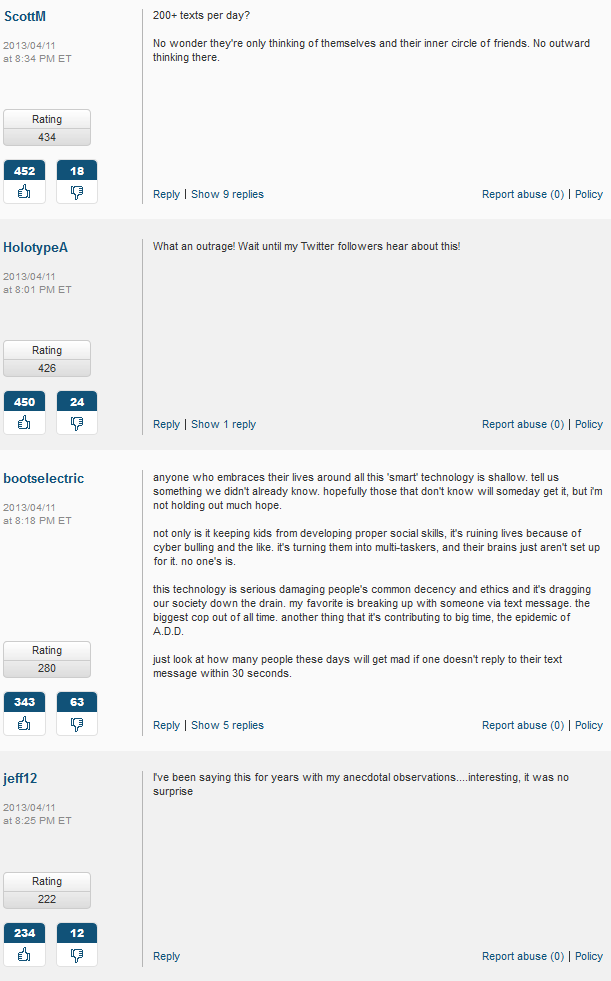
A recent CBC article claims a few things so startlingly obvious that the sound of a gong ought to be looped over it. The findings demonstrated, and you might want to sit down for this one, that people who texted more (don't sweat, the breakpoint is 200 + texts) often tended to be less thoughtful than those who didn't. Also among the findings was the gem that the 200+ text club was (30%) more likely to be fixated on "wealth and image than an ethical life". Now, as unsurprising as this study's conclusions are, they are of limited truth.

Firstly, only teenagers or immature adults can actually muster up the energy to text more than 100 times a day. Yet I can be surprised by texting culture. At 15 seconds per text, 100 texts would only require a time investment of 25 minutes. Scale that any way you want, and remember that serial texters are quick, and it's easy to conclude that a serial texter can text 400+ times a day and still have lots of time left over to socialize 'face to face' (oh shit, that term is going to get worn out in the next few years). This 'texting' business, which is correctly SMSing business, has for many years now been a cultural crisis in the making. We all stepped in it with full confidence, so now we get to suffer it. Suffer the outrageous extremes of an increasingly dim and unfunny era.

You can already see what kind of User Comment Rodeo it's going to be. The best kind. Because you know the ageists, the trolls, the dickweeds, the self-described experts, the geniuses – in short the whole, illiterate, unwashed, entitled, self-satisfied mass of the public – is going to unable to prevent themselves from puking their word nonsense onto this story like tainted cocktail shrimp at a bad house party. Listen up, I know that serial texters are often total wankers. I understood years ago that they lacked the self-reflection expected of a great ape, dolphin, or crow. Don't forget that this study is biased: note that it focused on first year students. Don't buy into the hype without thinking critically about it first. First year students are so rarely aware of themselves that the study is unfair and biased. It stooped for low-hanging fruit when there are plenty of studies that can judge the adult narcissist sociopaths in business, finance, and politics.

But enough of my ado about nothing; let's have others' ado about nothing:


The cream of the crop, my friends. These posts were not only so good that some people voted for them, but upwards of 200 votes were cast per comment. Can you spot the deafening irony? Should I even bother? Instead, bring your attention to the post by the user named 'bootselectric'. Oh, how the point is missed. The biggest cop-out, btw, is getting fired by text message. That shit actually happens. Oh and nobody 'embraces their lives' around anything. Anyways, all of these posts (worthless activities on a worthless medium - yes I understand the height of irony that is my acknowledging this) were voted for more than 200 times. Irony.

4/8/13

The Walking Dread

I've seen and heard a lot of shit talking about the recent Season 3 finale by a lot of self-satisfied idiots and I've got to say a few things in defense of the show AMC's The Walking Dead really is. I remember when a metal kid tried to sell his collection of Walking Dead comics to me after I mentioned to him I'd seen the first episode. I remember the person who introduced me to the show saying "It's fantastic" and showing me the first three minutes before his wife told him to shut it off so we could watch Secret American Boss or something decadent and ridiculous. Spoilers upcoming.

Whenever zombie media is brought up, I have to mention Night of the Living Dead. It's the de-facto best zombie movie. The only one worth watching twice (except maybe Shawn of the Dead which is worth a second viewing to catch references and if you're really stoned maybe a third viewing). Now, that night didn't spawn the end of the world, the movie resolved in fatalistic horror beyond anything, and before established tropes made 70's and 80's zombie movies predictable and half-satisfying (aside: media consumers are zombies and require FRESH ENTERTAINMENT TO CONSUME - cold corpses just won't satisfy bottomless appetites and stunted taste).

The old irony, which used to be a joke and is now itself a shambling corpse of a joke, is that the zombie outbreak scenario has itself become zombie-like. Except it can't be killed at all. It's been shot in the head (lost cultural relevance and profitability) and it's gone right on (until culturally profitable) without changing too much. Movie after movie, book after book, comic book after comic book, concept album after concept album, and finally TV show. AMC's The Walking Dead really debuted at the exact cultural moment (zombies were trending, yo), and had a sense of grit and human drama that pulled in millions of dedicated viewers, some of which told me how good it was every time I'd see them.


Anyways, after months of not watching the show I got tired of hearing about how good it was. Anyone worth a damn knows about Night of the Living Dead is the only zombie thing that will ever be a timeless classic. I am just putting that out there so that tasteless hacks shut up about the #YOLO of zombie entertainment. However, I am willing to concede certain things about AMC's The Walking Dead.

Firstly, the production values are readily apparent. The presentation is not half-assed, and outright better than most movies. The gore is fantastic and the zombies look downright good. There are no cut corners. It's a fantastic effort on the visual front. Abandoned city scenes in a TV show, shot in an actual city? People listed the production values a lot, 'most expensive show ever' etc... and I can't say how true it is but it seems right. This got people thinking that the show could only go up, as if an insanely talented and well-supported group of people could carry the show just by making it look good.

Second, regarding plot. The show stems from a comic book series but isn't an entirely faithful adaptation. This annoyed some people. Well one of the first things I noticed as I watched the first season was how torturously stretched every episode was. It helped for tension, and undeniably hooked an audience, and was admittedly a smart way to set up a 6 episode season. But let me spoil the show for you: it doesn't stop stretching the plot out. That much never changes, and lots of people who bitch about it now are idiots who never saw this habit for what it was. Entire episodes go by (even in season 1) in which some minor thing becomes a huge deal and everyone talks about their feelings for twenty minutes, then there is some shooting and another surprise. It works fine for season 1, annoyingly enough, but the show was new and there was nothing else quite like it. Gritty.

The characters are alright. In the first season especially you'll find that a lot of time is spent exploring how humans and society would deal with the changes of a zombie outbreak. It's pretty cool, and the characters have depth, so what flashbacks there are are not entirely annoying. Cringeworthy moments happen anyways, but for the most part it's eminently watchable zombie television. I won't say the writing is outstanding but it's better than average. Let me spoil the show for you: the writing never gets good enough to justify the stretching. Some characters get tiresome - most do. There is lots of agonizing and less action as time goes on. Entire episodes go by where maybe three zombies are killed. It takes creeping minutes for people to die, say what they mean, or act on their impulses (hah). Hope you like dialogue exploring the sometimes complicated nature of human interaction in a post-apocalypse.

In seasons 2 and 3 the show has settled as the cast has found safety and settled. This slowed the pace and justified all kinds of stretching and lollygagging. Writers had to keep tensions high and inevitably things got a bit less lively and a bit more sentimental. The most tense moments resolve themselves in multi-episode character arcs that tend to end messily. Well. What are you going to do, write the show out of a corner yourself?

Third: commercials. People bitched about this, especially for the recent finale. Nobody likes commercials, alright already: just cool it. Let me be perfectly clear: you're a stupid fuck if you don't think your outrageously popular and successful show with huge ratings is going to be used as a goldmine by its broadcaster. Got that? A stupid fuck. Success has a price (or rather a value) that is non-negotiable.


Fourth: plausibility. This isn't a can of worms worth opening, even if you were using them to catch the largest, tastiest fish in the lake. But between the inconsistencies, the unrealistic portrayals of gunfights, the loose ends, the implausible locations nobody in their right mind would try to shack up in, the outrageous conflicts... not worth it. This is a show about zombies based on a comic book. I know it looks super real but you honestly can't expect any team of TV writers to actually make it an impenetrably realistic depiction, right? Just use your imagination, don't worry about filling in all the blanks – this isn't highschool, nobody is grading you for being sharper than the total colossal dimwit idiots who write for a multi-million dollar TV series.

Let's fast-forward a bunch. The third season has concluded and anyone who has read a book or watched a TV show could tell you what was likely to happen. The whole season varied wildly from tense and exciting to bloated and mawkish. There were some good moments and the whole thing was building up to a huge bastard of a shootout, despite a determined pacifist angle. This more or less got stretched out over multiple episodes, some unrelated, in which everyone was getting guns and soldiers and preparing for a fight. It was annoying but shouldn't have surprised anyone with the attention span sufficient to remember what the first, or second (holy stretches) seasons were like.

AMC's The Walking Dead season 3 finale wasn't super-duper great by any stretch of the imagination. Lots of things were stretched out and painful, there was a weird bit of genocide, and it didn't really resolve to anyone's satisfaction. It left a lot open for the next season, which makes sense because the show is still zombie-popular. There was some heartfelt stuff, and even if it wasn't satisfying, it tied up a few loose ends. Idiot viewerships missed the point, which is funny but kind of sad, as the show isn't really that complex. In general the show delivered what it was going to deliver, based on past seasons, and it was exactly what the viewership deserved. Comic book readers still look down their noses at it.

The writing isn't total shit and the show isn't a piece of shit. People got really into this, just like with any successful TV show, and it didn't deliver perfection. It didn't quite manage to exceed the hype. Entropy, maaaan. Nothing's going to get better. Your biased memories and hopes are generating expectations that cannot be met by a human production. It can't be easy to maintain a juggernaut of a show like that, either. I'm sure the challenge of getting it done on time and keeping the production team together cost a bunch of really good episodes and a better show entirely. Whatever, though, it's TV. It's TV's only zombie show, so with your utter lack of alternatives you will watch anyway.

There it is. It's good television gone slightly wrong, but it's not a big enough deal and not enough has really changed to the point where you can say it's like old/new Simpsons. Don't make the mistake of looking around to see what people think. You'll know when you watch this imperfect bit of zombie television, guilt-free. Just do yourself a favor and watch the real stuff. Then you'll see that getting upset over the show is hardly anything. The theme hasn't progressed much, if at all, because it is undead. Then go out and watch World War Z, and moan about that too. You'll either ignore it or consume it, but as a consumer either way; and as part of the problem, you're not owed a damn thing.
4/1/13

Killing Minutes: Tower Defense Redux

Probably you have many ways to kill time on the internet. Too many, but Flash-based tower defense games are always good for a few compulsive hours if that's your bag. A while ago I wrote about Cursed Treasure and essentially gave it GOTY status among its overpopulated field. Luckily enough, the sequel was recently released, and it's great. How great? So great. I'd say it's a fitting sequel in terms of quality and entertainment value. It's free, after all, so it's absolutely a great value. Allow me review it, so you don't have to formulate an opinion yourself...


Presentation: Top quality. You can tell that a great amount of work went into everything: the UI is reworked and very appealing, the enemies look top notch, and the spell effects are 'cool fantasy game' level or better. Essentially it is a flat, 2D kind of thing, but it has depth and obvious artistry. The story is a humorous version of barely-there, but all you need to know is that you got to keep all the dudes away from your gems by any means necessary. The sounds are well-done, though too many Orc bunkers will short out attack sounds and the music is repetitive as you'd expect.

The spells and skills have been reworked and so have the towers you will use to destroy the gem-seekers - mostly predictable but with good variety. The design is all-round excellent, but the power-ups that randomly drop can quickly become a large pile of clutter in your culling zones, which can make it hard to pick up that coin you need or cast the right scroll. Mostly you can spare yourself this effect by tower-placement and actually picking things up.


Difficulty: The difficulty curve is a bit steeper than in the first Cursed Treasure, and levels off a bit more quickly when your skill investments start to pay off. If you've beaten the first game (and I'd recommend starting with it and the level pack, because they are great) this game will not present too much of a challenge, but there are a few devious levels. There's no need to get overconfident unless you are a TD-mastermind, but on the other hand a few old maps (see above) are reused – the difficulty in beating them the first time is obviously high, but if you 100%ed the old game they'll be relatively easy this time around. Well, to those I would say: enjoy the tricks this game has up its sleeve – there are a couple of truly fiendish levels that will test you. Ultimately I would hazard the opinion that this game is a little easier, overall, than the first. Not that it matters greatly, as you'll be well into the game by the time you outwit or overpower it.


Entertainment Value: Even if you hate badges, the game has replayability built in in the form of night-time maps which provide extra challenge and more XP, because you've got to be and XP addict by now. Sweet, sweet, honey-sweet EXP. Some maps will take a few replays to ace, and you'll want to ace all of them for XP. If you sign up for an Armor Games account there are 'quests' you can do which are like bonus achievements with real-world numbers attached – great if you want to 1% this game and prove to yourself how hardcore and elite you are.

Conclusion: It's great, it's free, it's well-made (maybe a little system intensive) and it's an absolute time-killer. If you doubt me, just go and see for yourself. It's early in the year to award this game GOTY (Flash, free, internet) status, but the challengers will really have to step up their game to compete. It's the best challenger for the title thus far. Iriysoft has outdone themselves in many ways on this title, and deserve a round of accolades (or drinks).

3/23/13

New Sincerity and You: Counter-Counter-Countercultural Warfare

In today's culture of needy oversharing, cultural voyeurism, and [post-]post-modern irony it can seem as if nobody is willing to simply be their own self. It's possible that being a human being will no longer be as attractive an option as it used to be in the so-called 'simpler times' but most likely it is the old struggle in which mass culture tries to either force itself to be interesting or lays down a smokescreen of excuses about why it isn't. A reasonably recent phenomena, born out of cultural desperation and distaste, is New Sincerity. And, goddamn, the term is hot right now, and getting hotter by the moment – so come inside, place your bets, and learn a little something about nothing!

I'm no expert. New Sincerity, as a term, doesn't sit well with me, just like so many other facets of contemporary cultural shorthand. In many ways New Sincerity can be simplified as the diametrical opposite of that vague modern boogeyman 'the Hipster'. And yet, research I have done on the matter seems to suggest that mainstream 'hipster scions' are in fact loosely associated with New Sincerity. I don't really know what Zach Braff would say about the matter. Was Garden State actually a determined piece of New Sincerity propaganda? Did it manage to cash in on the credible? Worse yet, have the bewildering, out-of-favor films of Wes Anderson been appropriated by the movement? By the other movement?

My intention in this article has changed from simply making fun of New Sincerity to undertaking somewhat of a census about it. Mostly this will be the type of armchair cultural criticism I am known for, worldwide. For the most part New Sincerity is often used as a prescriptive term. In music this situation changes: many bands, hearkening back to the simpler, more heartfelt times of Bruce Springsteen, term themselves part of the New Sincerity movement, performing lyrics based less on conceptualism and cleverness and more on love, loss, sorrow, joy, and excitement. These are the earnest topics for music, but what keeps them from becoming pop music is a blend of aesthetics, identity, and intent. The prime axiom is to be authentic at all costs by not making attempts at authenticity, and never to ask 'what is authenticity?'

Unsurprisingly, New Sincerity stems from classic rock superstars such as Bruce Springsteen, Ted Nugent, John Mellencamp, and Bob Seeger, among others. Hair metal and psych are too ironic, or too insincere, or illegal, so lots of 'dad-rock' played to death on classic rock radio is actually questionable. Or perhaps they are valid inspiration, it's quite foggy to me and researching these kinds of things is slower than decisive critical strikes. What have these (and other) roots inspired?

Modern popular/indie acts such as The Hold Steady, Japandroids, Passion Pit, and evidently even Animal Collective are considered New Sincerity. These are just loose examples. To my mind the absolute pinnacle of new sincerity is probably Japandroids - they're not as bland as The Hold Steady and they're not politically or philosophically newly sincere. They just rock out and sing and holler and scream about partying, kissing girls, how life is and what they feel about it.

It's not slavish imitations of Springsteen topics about living in a shit down and running out of hope, or shooting up a bank in the back-roads of Nebraska. One has to admire the mixed positivity in songs about change, nostalgia/heartbreak, or raw excitement. The sense is that it's all youthful enthusiasm and angst, sometimes regret, and the energy cannot be denied. Their lack of pretense, deliberate simplicity and raw force all stand in contrast to established hype bands like The Hold Steady (with Springsteen and hearts worn on the sleeves). However, Japandroids' sophomore album is either too earnest or actually ironic in the ennui mode (or simply underwhelming after their debut), which may or may not say anything about New Sincerity.

Myself, I think the best part is that New Sincerity is often hailed as the redemptive force of contemporary hipster culture. It's a pretty great lie, but it makes everything seem much more epic and heroic, as if there really is a struggle against insincerity in culture. I stress, again, that the modern hipster has roots in Victorian England and earlier German youth movements. We see again and again the sorrows of young Werther in the trappings of a modern-day dandy. However it was inevitable, after the crushing nihilism of the 80's and the strung-out apathy of the 90's, that some kind of cultural force would rise in opposition. The only questionable thing is whether terming it 'new' is not a smidgeon untrue.

3/20/13

Hype Level Critical: Age of Wonders 3

Age of Wonders is the holy grail of fantasy turn based strategy/RPG mashups. Age of Wonders I is a highpoint beyond even the Heroes of Might and Magic series, the Disciples series, or arguably even the slightly unrelated Civilization series. However, the (for a long time) final game in the series was released in 2003, which left possibly the longest shadow in gaming. Age of Wonders is a non-AAA series, in part because it never developed Warcraft's following and also because originated in (the final years of) an era when there were more publishers and less-AAA series. Multi-million dollar advertising budgets were also extremely rare in those days, but notable exceptions exist (PS1 and other consoles, Daikatana).


When the first game was released in 1999, it already looked outdated. In the modern era it would hardly pass (graphically, among the subnormals, children, and hacks who review games) for a half-assed indie title - even in 1999 (a time when, arguably, nearly all graphics were primitive and 'ugly') it was often remarked upon negatively for its graphical shortcomings. Nevertheless, since the game was a product of pure craft, what graphics it did possess were A) infinitely presentable, and B) charmingly executed. Honest reviewers acknowledged that if the presentation wasn't cutting-edge, it was passable, and in any case it was paired with deep, engaging and challenging gameplay. It also had a magic system that was deliciously broken, and crafty players could discover all sorts of hi-jinks to turn themselves into demigods.


The series might not have ever developed Warcraft's following, but among the hardcore Age of Wonders I is generally acknowledged as a masterpiece. I hate using the word 'hardcore', but that's what it comes down to: the game is unforgiving and if you cannot handle strategy, tactics or adversary, it is best to avoid it. It is one of those games which requires tact and some trial-and-error. There is no hand-holding, and losses are inevitable. The sequel (and its standalone expansion) carried on the tradition with varying degrees of success. The first missions alone can prove, on easy, more difficult than entire campaigns in other games, levels can take long and get brutally difficult even against basic AI. I would not go so far as to call the game masochistic, myself, but others might – odds are they're softies, though, with no real appreciation for challenge and glory.


With the modern explosion of game sequels, it is ultimately unsurprising to see the return of a great series backed with significant nostalgia. Yet the story is probably the best of the year (which is already a good one), even better than the Age of Empires II HD release. One of the best parts is that the success of Minecraft is partially responsible, which means that, whatever you think about Minecraft, it finally gave back to the community. I say all this before Age of Wonders III is even released: good news is good news, and I am happy about this.

After the Nerd Bubble article it may seem that I am a cynical outsider to nerd culture or even an elitist myself, but I am simply a lapsed gamer who used to care too much. I continue to play AoW1 because it is that good, and GOG.com sells it at a fair price (and sometimes a steal price), so anyone can play it even on the most modern hardware. This is truly the best era of gaming: even the ghosts of yesteryear are coming back to life. However, I would like to caution myself and others who are getting hyped already. Let's keep our expectations realistic.

The more I read about the AoWIII project, the more I like it. Michiel can den Bos, who composed music for AoW1 (not to mention Deus Ex and Unreal, two other dear favorites of mine) is apparently on board. Truly good news, because he never did a bad job of scoring a game. Evidently the old crew is, for a large part, assembled on the project. Triumph Studios are no loafers and I don't expect they will release a garbage bag, but it's been a decade since they've tangled with the AoW series. The main question, quite possibly the most pertinent and exciting question, is whether or not Age of Wonders III will recapture the magic of the first game. To do so will be a challenge - the first game had something like 12 races and unit exposition for each and every of the 48+ units. Just to execute this small part (which had much to do with the 'sense of magic' in the wondrous debut) can be difficult, and to ignore it would annoy at least some fans.

3/1/13

The Return of Community

It was a long time, and now the show has returned for all of four weeks. There has been a Halloween episode, a premiere, an episode about an in-joke, and just this past evening the first episode in the busy itinerary to actually take place in a more or less normal day at Greendale. I think it's been a long time since I've talked about the show. I'd like to make some comments about it.

Firstly: I'm glad it's back. The four month delay was probably because NBC was considering shit-canning the show for good. Season three was almost unbearably meta at certain points, but then again so was Season 2. Any purist would only accept Season 1 minus the paintball episodes as the true greats. If you want, you can identify a purist by how they will maintain that the paintball episode 'was a bit too much the first time and definitely overplayed as a two-part special.'

For the record, the first paintball episode was what drew the show into a 'hype updraft' which lasted roughly until the end of the first half of the third season. By that time, several characters lay in ruins, multitudes of fans felt betrayed and increasingly disturbed by the show's directions and obvious funding cuts, and every casual viewer had stopped watching entirely. Season 1 had become a memory of a brighter time, when the show had no popular appeal because it was simply excellent and fresh and 'too smart' or whatever down-talking supporters tell themselves. To be fair, Community Season 1 was a damn lot brighter than Two and a Half Men or the Big Bang Theory, and easily more fun to watch than anything that year.

What happens if you talk to a purist now, and you like the show? Tough question. Good luck with that, actually: I can't answer it. I have no idea what would happen, but it would be like admitting you prefer the second season. I was a particularly rabid fan during the time of the first season, but that was only because there were not a lot of good TV shows on network television at that time, and essentially zero good new series, and I needed distraction because I was a useless head case with a shaky full time job that would ditch me just in time for the Christmas Episode - which can be compared to anything the show has done since and still be puzzlingly superior despite how basic it is.

2009, around the time Community premiered, was another era. Dollhouse wasn't cancelled yet. The Recession was still fresh in everyone's mind. The 2012 elections only took up 15% of daily newscasts. Ghaddafi was still alive. Glee hadn't yet fallen so astoundingly low, and making fun of it was still sportive. 100 Questions hadn't premiered yet – and to me, this is important to note, because when it premiered in May it was return to the awful network television standards that made Community stand out so much in the first place. There have been few television experiences as jarring as Community finale-ing one week and the Worst Show Ever premiering the next, ushering in the season where healthy people stop watching TV. I am still kind of incredulous about 100 Questions. It is my Abed Moment, and makes absolutely no sense to the observer.


2/21/13

Words: Apparently Dumb, Stupid, and Easily Misused

Words are apparently stupid, because when you attempt to write many of them on the internet for any purpose you are missing the point. The internet is all about ADD, ADHD, and Twitter. Twitter's got it right and I've got it wrong. And I've had it wrong all this time. Paragraphs, sentences, and long-term writing are stuff of the 20th century and earlier.

I am not savvy enough. Don't believe me? My smartphone doesn't have apps or even a data plan (which makes it a part-time computer with built-in phone capabilities), my Twitter account has no followers (because I don't tweet and forget [my password constantly] to check Twitter unless some really hilarious hashtag is imploding),  and my blog is full of words and skimpy about pictures, videos, and excitement. What a fool I must be to keep at it: like it's some kind of book ebook that I'll never finish and that nobody cares about anyway. Like one of the stories Machine of Death rejected.

This blog is like an Angelfire crap page except not written by a child, no stupid .gifs or burning text, and no annoying MIDI covers of Limp Bizkit songs. So maybe it's not like an Angelfire/Geocities abomination... but why in the hell can't I figure out a way to capitalize on A) putting effort into making a way cooler blog [is this even possible] B) marketing this blog since I care so much. I can't have one without the other and, to be honest, I'd rather skip both.

Making a blog cool, even with idiot-proof software/front-ends [sorry Blogger], isn't as easy as I think it is. I'd have to scrap Publicato and try something new, losing probably everything that I struggled to build. But, honestly, if all I'm going to do is write stuff, link to stuff, and occasionally drop a screengrab, then I might as well go with a less tacky layout.

I will take a look, and feel the pain of what I imagine are actual human readers (unless even this is a delusion, and I've just attracted a lot of search-engine crawlers). Wood grain accent – like an 80's station wagon – black text on white background within it (ugly, amateur) in a non-offensive font at the very least. Flawless punctuation, occasional misspellings and typos despite a clear pro-professional writing bias. Nothing cool at all. High concept in words, not execution. Nothing hand-coded or done lovingly. Lodged in the belly of a content farm.

So that's why I don't always update. I always think that I am fooling my fool self with a fool blog on the internet. I play blues records and drink, and I hate that I ever started a blog at all. People make money off of facebook pages and twitter accounts, the odd blogger goes on to get published by an actual website, and almost everything I write is instantly drowned in the deep, still waters of the internet. It seems to me a hopeless case of building with sand on sand. Holding water. Fooling an eagle. Being angry at a dolphin.

That is to say: impossible. Writing is like smoking cigarettes: it stinks, it's bad for you, you end up making the wrong friends and distancing the right ones. Writing on the internet with more than 500 words at any one time is like being Henry James (or Theodore Drieser) at a post-modern microfiction literature convention. You can practically feel the cold shoulder given you by anything cool or contemporary. Who gives even the slightest shit?

2/13/13

Danielle Steel's Poetry, via Tina Fey

For today I thought I'd keep it simple and uncontroversial, but above all entertaining. I also wanted it tinged with nostalgia and ridiculousness. The research did not take long, but it was conclusive and the results are high-quality and thorough. Let's take a trip to the unrecoverable past, and weep.

This is what happened before Twitter. Now this kind of awesome transmission of hilarity is less constrained but even more inaccessible. It has grown from the constrained television/early-internet arena into a lawless continent. You might term it the twitterverse, or twitter galaxy. Late night TV isn't the most accessible thing, but goddamn if it didn't serve up some great times.

I remember the happy times on this very blog, when it seemed all I could do was watch late night TV and then post on this blog about it. I should've kept on with that business. I could've had an audience, but I choked. There aren't enough commentators and content-generators on the internet already, right? Any smart person could see how late-night TV commentary is an untapped market and how I could –

But I wasn't that smart person. The Jesse Navarro episode was a sign that Conan's show has the same kind of potential to be awesome. There is interest and potential discussion, refreshed each night, totally different each week, yet comfortingly similar and routine. There was so much to write about: Jimmy Fallon's meteoric but dubious rise (and amazing musical guests and the Roots!!!), Craig Ferguson's amazing cold opens, Conan's uninhibited but too-clever hilarity, and of course the underrated genius of Jimmy Kimmel.

If I could go back, this would've been a niche blog with a design document. Look around at the lack of progress, at the wreck of a blog.

(The book in question)

2/12/13

User Comment Rodeo: Pot Still a Huge Deal

It's downright unhealthy. It'll drive you crazy and ruin your life. It's a gateway to worse things. The User Comment Rodeo is, in fact, all of the above – and more!

Marijuana, for God knows what reason, is still something people get riled up about. Despite being illegal, it is found everywhere, in most countries. In certain places it is policy to execute or imprison people for marijuana crime: the stakes get higher than the high. Its legal status in free countries, and surrounding discussion, is one of the most indicative dramas of our epoch. 


Every time legalization fumbles, the same crowd comes out to jeer. Many consider it the finest part – the choicest cut of commentary – but in many ways it is a joyless spectacle.


Sensationalism is never where the show's at. There are finer tastes (even though it is understandable to ignore them). Consider the above: a beautiful and puzzling moment in the blizzard of opinion – another beautiful snowflake. A natural, logically formed moment in time, among all the rest. Arguments are always made noticeably better by:
1. Organization
2. Rhythm and Repetition
3. Dope


You can't be afraid of the deep end in this business. The shallow end is easier to understand, but what you miss out on is nuance. Don't fear the deep end:
1. It's Deeper
2. Paying Attention
3. Digression: Creates Perspective


Morality is key, because let's face it: user comment boards are highly influential and very important for public discourse. The picture they paint will always be a masterpiece. But to paint a masterful picture, the artist must reach into the soul of the audience – pulling on the heaviest of heartstrings and reading unthinkable terrors

2/5/13

Advertiser's Bowl: 2013 Edition ft. Existential Ennui

I don't have anything against the Super Bowl. It's a good reason to drink and eat too much and a great excuse for feeling like shit on Monday. What always puzzles me about it is how the Super Bowl Ad has become this huge event. Over the next week there will be Superbowl Ad Top 10s, reviews, and news segments. Most media output about the Super Bowl Ads will have the self-awareness of a gnat. I haven't been paying enough attention to say anything with certainty, but I think it's not really a high mark for society if the high-priced overpowering sports event of the year gets spectators who care more about the high-priced commercials and overpowering half time show. Ravens fans get to feel good, but then again: Baltimore's still going to have its problems, as will we all.

Each year, lately, people get psyched up for the Super Bowl's pricey, overblown, ridiculous commercials. Newscasts neglect problematic, boring stories for the innocent pleasures of the advertisement adventure. Meanwhile grown men have been sacrificing their bodies for... shit tons of money and a good start at fame. The themes seem to run together. There are always some 'innovative' ads, in the loosest sense of the word, but getting excited about innovative advertisement is like getting excited about a new model of taser. It's like getting excited about being in pro sports, but realizing that you may go to shit in the process: we should be so lucky to waste ourselves for such a prize.

For all their expense, commercials are generally devoid of value, promote unhealthy ideas, reinforce stereotypes, lie, cheat, flatter (in the basest sense) and bully the populace. Innovation? Most don't even have the good grace to be entertaining. This year Dodge released a high-quality, high-concept pro-farmer commercial so exceptionalist and baldly desperate that it almost touched the heart – but then again: Dodge is only another part of the dust bowl. What do farmers even matter when the whole proceedings only preach dust bowls?

In spite of all that craziness, I think by far the worst Super Bowl memory I have isn't an advertisement or the spectacular failure of a deserving team. No, my personal darkest moment is when Undercover Boss premiered after Super Bowl XLIV. It was stunning. What a brilliant PR move, but how absolutely disgusting to see something like that and then the uncritical, even positive response. This evil show was embraced. People were and still are enthusiastic about it. Advertainment, another slick evasion of issues such as predatory zero-sum business practices, income inequality, and the Recession. The smug laughter that inevitably results.

I think it's the kind of show that is okay to hate. I don't use the term evil lightly. Evil is a shared burden and all that, but it is okay to despise this goddamn show. It's  toxic, terrible, manipulative and the lack of popular critical response is a sad fact. It showed that soft power knew no bounds: it could take criminals, crooks, bullies and turn them into angelic, benevolent, personable superiors. I have no doubt the executive class is generally not evil, but their culture is not a healthy or positive one. I'm not an idealist to the point where I will deny the fundamental importance of business or industry, but the mere plight of the average modern person unsettles me. The way the earth – life – is used has gone far beyond the point where we can be unthinking and proud about it.

I don't get how such a transparently biased, exploitative show can still be on the air two years later. It is readily apparent that nobody has learned anything in the meantime, and that executives are just as wealthy and powerful as ever, what with the labor market wheezing and slumping like a dying hobo while the screaming middle class sinks. All you have to do to mask the dark side of capitalism is: videotape your choice of 'boss' talking about or doing awkward unsatisfactory work, in a sanitized and tightly scripted environment, edit to taste, pick some compelling underprivileged or overworked employees, wrap it up with a heartwarming situation, some cash prizes, and a teachable moment or two. Because the bosses do care: and no drudge's futile trudge through wage-slavery goes unnoticed and unrewarded.

Like any commercial, Undercover Boss delivers bias and sells misinformation. It meets minimum thresholds for propaganda. It portrays one point of view faithfully, and damn the rest – like the Simpsons, and many other fictional television shows. For instance: I joked some years ago about the five thousand dollar suit. Oh, hell. This is likely show money, which the boss gets to give out in order to humanize them (via #rotecharity). Sometimes an additional prize of changed terms of employment are entered into the bargain. Then tears. Let me tell you something about pathos: dollars alone don't make it convincing. The bosses cry crocodile tears, and the employees cry about the smug charity that will hopefully better their lives by some obscure fraction. 

I tell you of such scenes, not because I follow the show religiously but because I earnestly believe that that sort of indoctrinating pablum should be reserved for what are explicitly aired as advertisements. Undercover Boss contains enough slick reality-TV features to pass as a show, but that's a mask for what is really an advertisement for the same broad attitudes which have time and time again put the majority in the corner and the minority in comfort. At the end of each episode money changes hands, and nothing significant changes. The landscape of exploitation remains the same, and objecting to it still results in a defensive reaction from the world's largest, wealthiest, most powerful guilty party.

We keep worshiping opulence, and when it inevitably fails and bankrupts us, we find that consumerism is a sweetened abyss anyway. Everyone is sick with it. The rational mind knows* it is madness to overproduce, to hoard, and to waste – nevertheless: it's a race to the bottom and nobody can afford to miss out. There is only one way down.

(*or ought to, if it is at all thoughtful)